
Business tools guide
How to read an LEV test report, and what to do when a hood fails
By Jason Burns Published 9 minute read
Two documents, one benchmark
An LEV test report is the written record of a thorough examination and test of a local exhaust ventilation system, showing for each hood whether it still controls the hazardous substance it was installed for, and what has to be fixed where it does not. An LEV system should produce two kinds of report over its life. The first is the commissioning report, written once when the system is installed or changed. The second is the thorough examination and test report, written at least every 14 months. The second only makes sense against the first.
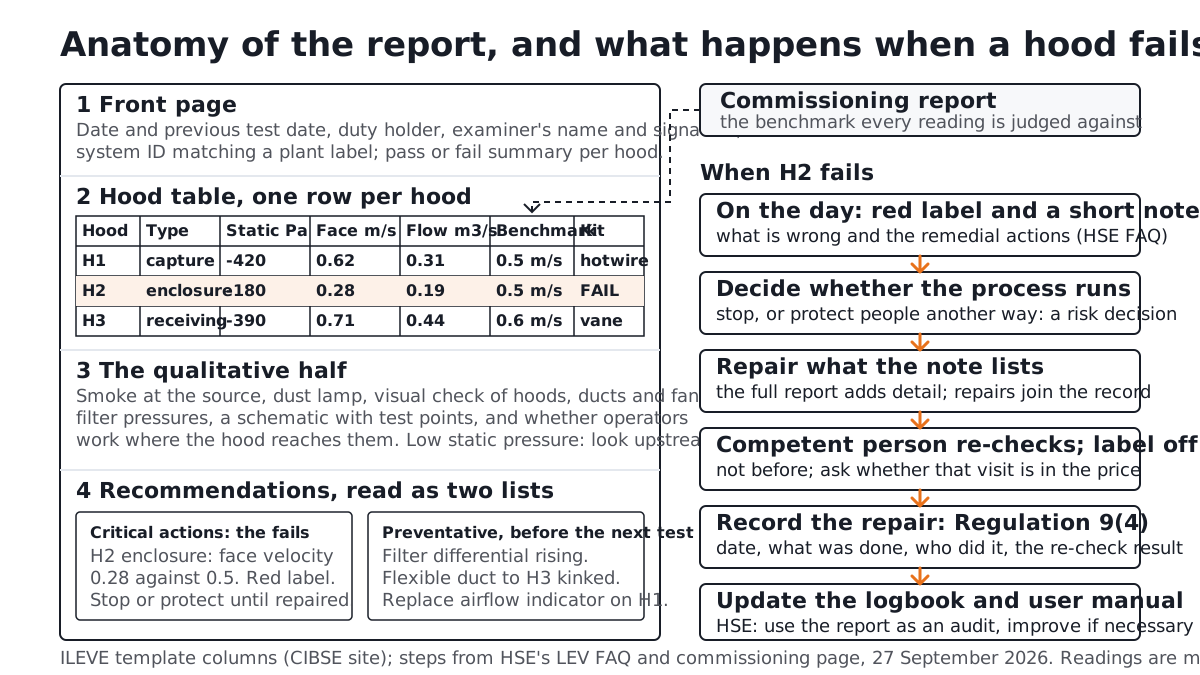
The report's four parts on the left, and the six steps after a red label on the right.
HSE's commissioning page puts it plainly. Commissioning "proves that the system is providing adequate control" and "provides a benchmark for later regular examinations and tests". Filtermist's page on commissioning reports says the same from the supplier side: commissioning "sets the benchmark for future LEV tests". If the test report in your hand has no reference to intended performance, it is measuring against nothing. HSE's FAQ says the employer should be able to give the examiner "information about the intended or designed performance of your system eg hood type and position relative to the process, airflow and other measurements".
So before reading the test report, find the commissioning report. If there is none, HSE's FAQ says the intended performance may instead have been "provided as standard operating data by the suppliers of extraction equipment" for simple stand-alone systems, or may be found in recognised guidance such as COSHH Essentials. The examiner "should let you know whether the information you provide is adequate".
What the front page should tell you
HSE's commissioning page lists what a commissioning report "should always include": the date of the test, the duty holder's name and address, and the commissioner's name, job title and employer. It adds: "Ensure the report has been signed appropriately." A thorough examination and test report should carry the same identity block, plus the date of the previous examination so the interval is visible.
Then look for a system identifier. HSE describes the commissioner having "identified the LEV system and location", giving a unique number assigned by the tester as the example. That number should match a label on the plant. If the report says System 3 and nothing on the shop floor says System 3, ask the examiner to label it before they leave.
Then the summary. HSE says the commissioner "should include a simple summary describing the effectiveness of the system". For a test report HSE's FAQ is more direct. The report "should clearly show whether this is the case and if it isn't, the report should clearly show what is wrong and what needs to be done to correct it". A report that buries the pass or fail on page nine is a bad report. You should be able to see the result for each hood before you reach the numbers.
The hood table
Most of the document is a table with one row per hood. A commissioning report template published on the CIBSE site under the ILEVE name is a fair picture of what you will see. Its hood table has these column headings: Hood Ref; Type, one of "Receiving | Capture | Partial | Full Enclosure | Other"; Dimensions in metres; Static pressure in pascals (Pa); Face Velocity in metres per second (m/sec); Air volume flowrate in cubic metres per second (m3/sec); Future Benchmark; and Test kit used, "Hotwire / Rotating Vane".
What each column is telling you:
Type. A capture hood sits beside the source and has to pull the contaminant towards itself. A receiving hood sits where the process throws the contaminant, above a hot process for example. An enclosure surrounds the source. The type decides which measurement matters most.
Face velocity (m/s). The speed of air entering the hood opening. For a booth or enclosure this is the headline number. HSE's commissioning page lists "face velocities" among the quantitative results a report should contain.
Static pressure (Pa). The suction in the duct behind the hood. On its own it means little. Against the commissioning figure it is the quickest sign of a blocked filter, a collapsed flexible duct or a slowing fan. A hood whose static pressure has dropped well below its benchmark has a problem upstream even if the face velocity still passes.
Air volume flow rate (m3/s). How much air the hood is moving. This is the figure the designer sized the system on. If the total across every hood is well below the commissioning total, the fan or the filter is the suspect, not the hoods.
Future benchmark. The template records a velocity and a static pressure to test against next time. If your test report leaves this blank, the next examiner starts from scratch.
Test kit. Hotwire and rotating vane are two kinds of anemometer. HSE's commissioning page lists "calibration certification" among the things a report should include. Ask for it if it is missing.
The template has a second table for capture hoods with "Capture velocity", "Capture distance" and "Is working zone in capture zone?" answered yes or no. For a capture hood that last column is the one to read. A hood can pass on face velocity and still fail to control exposure because the operator works outside its reach. The template also asks for a "Statement on effective capture zone", the method of test, "Smoke release | Dust Lamp | Other", and photographic evidence.
The qualitative half
Numbers are half the report. HSE's commissioning page lists "the methods used to judge performance, such as visual, smoke test, airflow measurements, pressure measurements, dust lamp, air sampling and filter testing", and asks for "qualitative assessment results, including suitable observations".
In practice that means a smoke test showing whether smoke released at the source goes into the hood or drifts past it; a dust lamp observation, where a strong lamp makes fine airborne dust visible; a visual check of hoods, ducts, filters and fan for damage, leaks and wear; and a filter section. The template's filter section asks for type, manufacturer, model, serial number, media type and filtration area, plus inlet and outlet static pressure and the differential across the filter.
A report should also carry, in HSE's words, "a simple schematic with test points", so the next examiner measures at the same places. The template asks for a line schematic of the key components and a dimensioned drawing showing test points and DSEAR exclusion zones.
The observations section is also where the report should record the condition of the installation as a whole: whether the process or the layout has changed since commissioning, whether employees are working where the hood can reach them, and whether anything about the design no longer fits the job. A technically perfect set of readings on a hood that has been moved a metre from the process is a fail in practice, and a good examiner will say so in the findings.
The recommendations page
HSE's outline for an on-tool extraction test report, on the same FAQ page, splits recommendations into two kinds: "any critical action needed" and "preventative maintenance recommendations before the next TExT". Read them as two lists. Critical actions are the fails. Preventative items are the things that will fail before the next visit if nobody touches them.
Regulation 9(4) of COSHH requires the employer's record to include the repairs that follow from the examination, not only the examination itself. So the recommendations page is not the end of the paperwork. Whatever you do about each item becomes part of the record.
When a hood fails
A fail is a hood or system that no longer controls exposure as intended. Beam's testing guide lists the usual causes: "Reduced or no airflow", "Poor contaminant capture", "Failure to contain dust, fumes or vapours" and "Damaged or worn components".
HSE's FAQ describes what should happen at the time of the test. HSE guidance recommends "that a red 'Failed' should be put on any hoods (or system) that has failed, to warn supervisors and operators directly and explicitly". And: "With the label should come a short 'emergency' written report containing a clear description of what's wrong and a list of practical remedial actions." So on the day, before the full report arrives, you should have a label on the hood and a short written note of what is wrong. If the examiner leaves without either, ask.
Then the sequence.
- Decide whether the process runs. Beam's guide says "use of the system should stop until suitable repairs or improvements have been completed". HSE's FAQ on on-tool extraction says to "address any critical defects immediately". Whether you stop the process or protect people another way in the meantime is a risk assessment decision. Do not carry on as normal because the paperwork has not caught up.
- Get it repaired. The emergency note lists the remedial actions. The full report adds the detail.
- Get the repair checked. HSE's FAQ says a competent person has to confirm the repaired hood "is effective and adequately controls exposure", and only then: "The 'Failed' label can then be removed." A repair without a re-check leaves the label on and the record open.
- Record the repair. Regulation 9(4) again. Date, what was done, who did it, and the re-check result.
- Update the logbook. HSE's commissioning page says the results should give you "enough information to update your user manual and logbooks after any defects have been resolved". HSE's page for employers lists "Fill in the Log Book and get repairs done" as a key message for using LEV.
Three questions for the examiner
HSE's FAQ lists three things to do with a report: read and understand it, "ask the examiner questions if you don't understand anything that it says", and act on the recommendations. The same page says a good examiner "will be able to tell you beforehand whether they have enough information".
Ask these before you sign the report off:
- Which figure did you test each hood against, and where did that figure come from?
- Which of the recommendations are fails and which are advisories?
- If a hood failed, who does the re-check after the repair, and is that visit in the price?
The report is an audit of a control measure. HSE's page for employers calls it that: "Use the thorough examination report as an 'audit'. Improve if necessary."
Questions people ask
Two of these come from Google's "people also ask" box for LEV report and two from its related searches. The answers lean on the HSE pages under sources.
What does LEV stand for?
Local exhaust ventilation. HSE's topic page title calls it "workplace fume and dust extraction": the hoods, ducts, fan and filter that capture airborne contaminants at the point where a process makes them, before employees breathe them.
Is an LEV test certificate the same as the report?
There is no certificate in the regulation. Regulation 9(4) requires "a suitable record of the examinations and tests" and of the repairs that follow. Some companies issue a one-page certificate alongside the report, and HSE's guidance recommends examiners "label each hood with a test record" so supervisors and operators can see the test has been done. The label and the certificate are summaries. The document you have to keep for five years is the report with its readings, and a certificate on its own does not show an inspector what was measured.
Do I need an LEV test for HSE?
HSE does not carry out the test and does not need to be sent the report. The duty is to have a competent person do the thorough examination and test at least every 14 months and to keep the record available. An HSE inspector may ask to see it, and HSE's employers page says to use the report as an audit. If the report says a hood failed and the record shows no repair, that is what the inspector will read.
What happens if the report finds a defect?
Read the recommendations page as two lists. Critical actions are the fails: the hood gets a red label on the day, the process stops or people are protected another way, the repair is done, a competent person re-checks it, and the repair is written into the record. Preventative items are the things to fix before the next test. Both lists become part of the Regulation 9(4) record once acted on.
Where LevHQ fits
LevHQ lists LEV testing companies by area so a workplace can find examiners and send one quote request to up to three of them. The report comes from the company you appoint, not from LevHQ, and LevHQ does not check the qualifications a company lists. A report-building tool for testers is in development and has not been released. The live directory is at levhq.app.
Sources
Fetched on 27 September 2026:
- HSE, Commission your local exhaust ventilation (LEV) system
- HSE, LEV frequently asked questions
- HSE, LEV information for employers
- COSHH Regulation 9, legislation.gov.uk
- ILEVE LEV commissioning report template (PDF on the CIBSE site); Beam Central Systems, LEV testing guide; Filtermist, "A closer look at LEV commissioning reports"; TUV SUD, LEV testing regulations and COSHH; LEV Central, P601 and P604 report template page. Commercial pages, not linked from here.
Related guides: LEV testing records and COSHH Regulation 9 and what LEV testing costs.