
Business tools guide
LEV testing cost in the UK: published prices and what moves the quote
By Jason Burns Published 8 minute read
Nobody prices it by the hour on a website
Ask what an LEV test costs and you get one of two answers. Companies with a published figure quote it per system, with a cap on the number of hoods. Everyone else says it depends. Both are honest, because what is being priced is an engineer's visit, not a piece of paper.
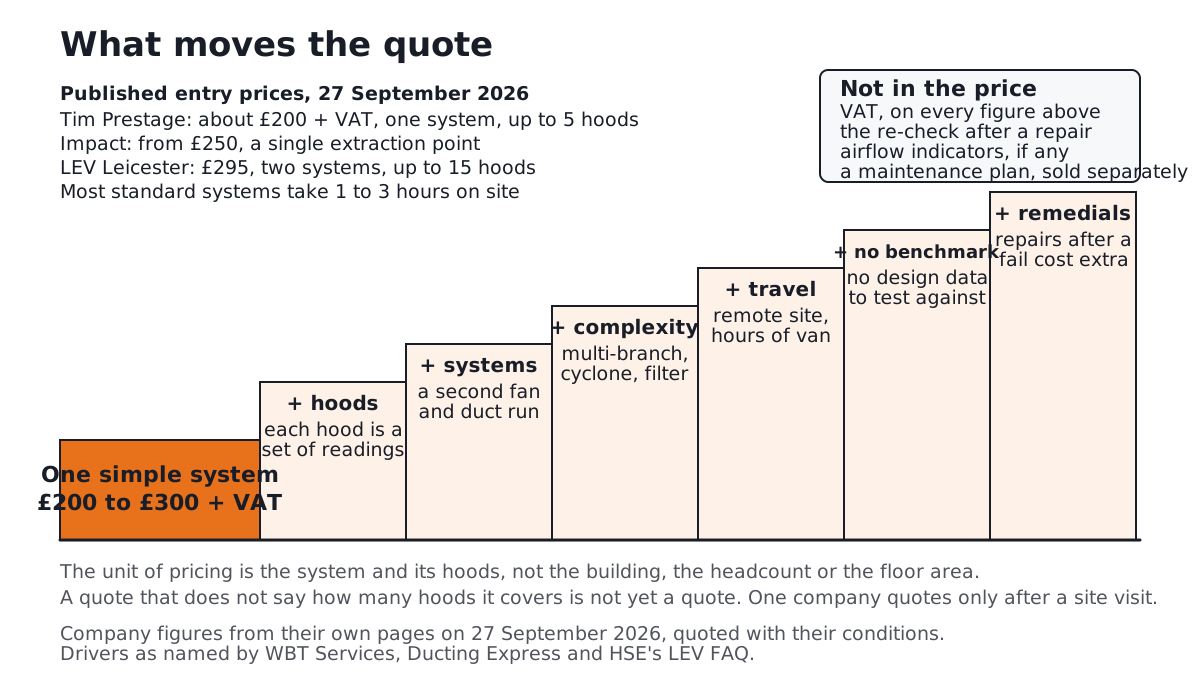
The published starting price, the six things that move it, and what stays off the invoice.
LEV testing costs between £200 and £300 before VAT for a single simple system on the pages that publish a price, and the unit of pricing is the system and its hoods. That sentence covers a bench extractor in a joinery or a fume arm over a welding bay. It does not cover an industrial multi-branch system, which is quoted on inspection, or the remedial work a failed hood produces.
We pulled the UK search results for "lev testing cost" on 27 September 2026 and read the pages that rank. Every figure below is that company's own published price on the day, quoted with its conditions. None is a market rate and none is our estimate. Use them to judge a quote, not as a price list.
The published figures
| Company | What the page says | Conditions on the page |
|---|---|---|
| Tim Prestage Ltd | "approximately £200 plus VAT" | For "a single system ie; a fan, ductwork, and upto 5 extraction points (hoods)". The same page says: "We will only quote after a visit to your site." |
| Impact Technical Services | "Smaller systems with a single extraction point can start from just £250" | "larger multi-point or complex systems are quoted individually" |
| LEV Leicester | "£295" as a worked example | "a Leicester-based factory employing ten people with two LEV systems consisting of up to fifteen pick-up points or hoods". An annual maintenance plan on the same page is "£695". |
| WBT Services | "a few hundred pounds" for "basic assessments for simple systems" | "more complex evaluations could rise into the thousands" |
| Ducting Express | "There is no set fixed cost for an LEV test" | It depends on "the number of LEV systems your business uses and where your site is located in the country" |
| Environmental Compliance Ltd | No figure | "Smaller systems with a single extraction point are typically less expensive, while larger or more complex systems with multiple test points will require more time and detailed assessment." |
Two things stand out. On the three pages that name a number, the entry point for one simple system sits between £200 and £300 before VAT. And the unit is the system and its hoods. Not the building, not the headcount, not the floor area.
Impact's page also says that for most standard systems testing "usually takes between 1 and 3 hours". That is the other way to read the figures: an engineer's morning, plus the report written up afterwards.
What moves the number
The pages agree on the drivers even where they differ on price.
Hoods and extraction points. Every hood is a set of measurements: face velocity, static pressure, a smoke test, a look at its condition. Fifteen hoods is fifteen sets. LEV Leicester's example puts fifteen hoods across two systems at £295 and Tim Prestage puts up to five hoods on one system at about £200. Those two data points show the per-hood shape of the market.
Number of systems. A second fan and duct run is a second system, even if it sits next to the first. Ducting Express names system count as the first thing the price depends on.
Complexity. WBT separates "basic assessments for simple systems" from "more complex evaluations". A bench extractor with a manufacturer's data sheet is one job. A multi-branch woodworking system with a cyclone, a bag filter and eight machines is a design question before it is a test. What the system extracts matters too: wood dust, welding fume, oil mist and solvent vapour are different airborne contaminants with different capture requirements, and the examiner has to know which one the hood was designed for.
Travel. WBT says businesses "in remote or less accessible areas of the UK may face higher lev testing costs due to additional travel time". Impact lists "local engineers across the UK to reduce travel expenses" as a selling point. If the nearest competent tester is two hours away, you are paying for four hours of van.
Missing benchmark data. The examiner tests against the system's intended performance, which HSE's LEV FAQ says "might be in the form of an initial appraisal or commissioning report". If you cannot produce one, the examiner has to establish that benchmark before testing against it. HSE notes that "many examiners can help you identify intended performance information". That help is work, and work ends up on the invoice.
Remedials. WBT lists "modifications or repairs" as a cost that follows a failed test and says these "can significantly increase the total amount spent". The test price is the price of finding out. It is not the price of fixing.
What the price does not include
Read the quote for these, because the pages we read do not bundle them.
- VAT. Every published figure above is stated before VAT.
- The re-check after a repair. HSE's FAQ says a repaired hood or system has to be checked by a competent person before its failed label comes off. Ask whether that revisit is in the price or is a second call-out.
- Airflow indicators. HSE's FAQ says a simple indicator suits low risk, while "more hazardous substances and circumstances may require more sophisticated, and potentially more costly, indicators eg with an alarm". Ducting Express says indicators "are recommended but are not mandatory" and warns of "scaremongering" from sellers. Decide on indicators from your risk assessment, not from the test quote.
- Maintenance plans. LEV Leicester's £695 annual plan is a separate product from its £295 test. A plan may be worth having. Compare it as a plan, not as part of the test price.
How often you pay it
Regulation 9(2)(a) of the Control of Substances Hazardous to Health Regulations 2002 sets the interval for LEV plant at "at least once every 14 months", or the shorter interval given in Schedule 4 for the processes listed there. A normal system is one test roughly every 14 months. Regulation 9(4) requires the record to be "kept available for at least 5 years". The regulation sets the frequency and says nothing about price. No HSE page we fetched names a fee for testing.
The cost of not testing is easier to pin down. HSE's cost recovery rates page lists Fee for Intervention at "£188 an hour for the time it takes HSE to identify what is wrong and to help you put things right". HSE's page on what FFI is says the fee "will include the costs covering the time of the entire original visit", multiplied by that hourly rate. One of the pages ranking for this query still quotes FFI at £160 an hour. The current HSE page says £188.
Getting quotes you can compare
HSE's advice on choosing an LEV supplier applies to testers as well. Its FAQ says to write a simple description of the work and hand it over, to ask about experience with your type of system, and to "always get more than one quote". It adds a line the other pages do not: "If the cost is high, it might be worth visiting other sites and viewing other LEV installed by the supplier."
A brief that produces comparable quotes fits on one page.
- Site address and postcode, and when the site can be accessed.
- Number of systems. For each one: what it extracts (wood dust, welding fume, oil mist, solvent vapour), how many hoods, and roughly where the fan and filter sit.
- Whether you hold the commissioning report or the supplier's operating data, or neither.
- Date of the last thorough examination and test, and whether any hood failed.
- Whether you want the test alone, or the test plus a quote for any remedial work it finds.
- Whether any process on site is listed in COSHH Schedule 4.
Send the same brief to three companies. If one quote is half the others, ask what it leaves out. Tim Prestage's page is a useful reference point here. A company that "will only quote after a visit to your site" is telling you that any price given blind is an estimate.
Questions people ask
Three questions from Google's "people also ask" box for LEV testing cost, answered from HSE's pages and the company pages in the table above.
What is an LEV system inspection?
The regulation does not use the word inspection. It says "thorough examination and test", and testing companies shorten it to TExT or call it an LEV inspection. It is the same visit: the examiner measures each hood, checks the ducts, fan and filter, compares the readings with the system's intended performance and writes a report. HSE separates that from the routine checks the employer does between tests. Its FAQ on on-tool extraction says that "as well as a TExT, you need to regularly check the equipment is in good working order", through "pre-use checks and more detailed maintenance inspections (eg weekly)". A company selling those checks as a service is selling maintenance, not the Regulation 9 examination.
Is LEV testing a legal requirement?
Yes, for any employer whose extraction is there to control a hazardous substance; the section above quotes the two paragraphs of Regulation 9 that apply. The price of skipping it is not a fixed fine. If an HSE inspector finds a material breach, Fee for Intervention applies at the rate on HSE's cost recovery page, "£188 an hour for the time it takes HSE to identify what is wrong and to help you put things right", and a Regulation 9 test would still have to be bought afterwards.
How long does an LEV test take?
Impact Technical Services' page says testing of most standard systems "usually takes between 1 and 3 hours". Add the report, which is written up afterwards. A large multi-system site is a day or more, which is why those quotes come after a site visit.
Where LevHQ fits
LevHQ is a live directory of LEV testing companies. A workplace searches by postcode, reads the profiles nearby and sends a single quote request describing the job to up to three testers. That is the brief above, sent once. LevHQ does not carry out tests, does not set or check prices, and does not verify the qualifications a company shows on its listing. Scope, price and date are agreed directly with the company you choose. The directory is at levhq.app.
Sources
Fetched on 27 September 2026. Company prices are those companies' published figures on that date and may have changed since.
- COSHH Regulation 9, legislation.gov.uk
- HSE, LEV frequently asked questions
- HSE, cost recovery rates
- HSE, what is Fee for Intervention (the FAQ and FFI pages were read again on 27 September 2026 for the questions section)
- Tim Prestage Ltd, LEV testing and certification page; LEV Leicester, pricing page; Impact Technical Services, LEV testing page; WBT Services, "Understanding the cost of LEV testing"; Ducting Express, "What is LEV testing"; Environmental Compliance Ltd, local exhaust ventilation testing page. Commercial pages, not linked from here.
Related guides: LEV testing records and COSHH Regulation 9 and how to read an LEV test report.