
Business tools guide
How to find an LEV testing company: six routes compared, and what none of them can tell you
By Jason Burns Published 9 minute read
Start with the uncomfortable fact
Local exhaust ventilation is the fume and dust extraction equipment that captures airborne contaminants at source before staff breathe them. The Control of Substances Hazardous to Health Regulations 2002 (COSHH) make a thorough examination and test of that equipment a statutory duty, at least every 14 months, and the inspections have to be done by someone competent. Compliance rests with the employer. Nobody licenses the people who do the inspections. The HSE's own LEV FAQs page says HSE names training courses in its guidance only as examples and does not require a supplier to hold them. The same page defines what you are actually looking for: "Competence is a combination of knowledge, skills and application experience that enables a person to do an effective and reliable job."
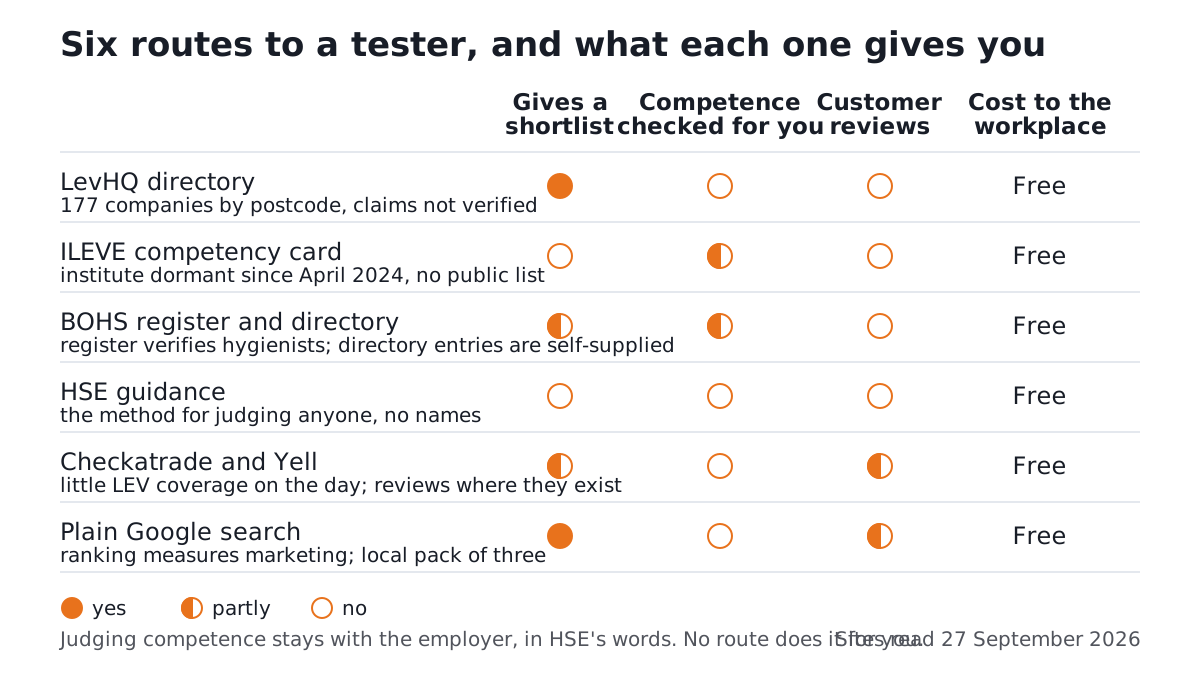
Six routes to a tester. No route checks competence for you, which is the point of the page.
That puts the job of judging a tester on you, the employer. Every route below, including our own directory, is a way of finding candidates. None of them does the judging. We run LevHQ, so read the LevHQ row with that in mind. Every fact on this page comes from a page we opened on 27 September 2026, and the source list records each one.
The six routes
| Route | What it covers | How listings get there | What it costs the workplace | What it tells you about competence | Limits |
|---|---|---|---|---|---|
| LevHQ directory | 177 UK LEV testing companies on 27 September 2026, searched by postcode, town or region | Companies claim or register a listing and a LevHQ operator reviews it before it is published; paid Listed and Featured tiers add detail and placement | Free to search and free to request up to three quotes; the tester quotes its own price | Company-supplied qualification and membership details on paid profiles. LevHQ's own pricing page says it "does not verify qualifications or certify listed testers" and that a paid position "is not an endorsement or a check of technical competence" | No customer reviews; coverage depends on who has listed; paid tiers rank above free ones within matching results |
| ILEVE competency card (CIBSE) | Individual engineers who were corporate members of the Institute of Local Exhaust Ventilation Engineers | Members were assessed and issued a card showing name, membership number and up to five accredited LEV competencies, renewed yearly with an expiry date | Free; CIBSE says employers can verify a card by email or phone | The closest thing to an independent competence check in this list, in named fields | CIBSE moved ILEVE to dormant status in April 2024 and the HSE's links page calls it "mothballed"; no public searchable members list was found on the pages read |
| BOHS | Two things: a Directory of Occupational Hygiene Services searchable by company, city or topic, including "Local Exhaust Ventilation - routine testing", and a Register of Occupational Hygiene Professionals accredited by the Professional Standards Authority | Directory entries are supplied by the companies, with the named contact being a Faculty of Occupational Hygiene member; the Register verifies individuals against its own standards | Free to search on the pages read | The Register lets you check an individual's verified level of expertise. The Directory does not: BOHS says an entry "does not mean that BOHS endorse the organisation or the individual" and experience levels A, B or C are the company's own | The Register's "LEV Specialist" level was described as "More information coming soon"; the Directory covers occupational hygiene consultancies rather than every extraction company |
| HSE guidance | No names. A method for judging anyone you find, and a links page naming trade bodies | Not a directory | Free | Defines competence and tells you what to ask for: qualifications and training, experience and previous work, references or testimonials | Will not give you a shortlist; you still need one of the other routes |
| Checkatrade and Yell | Household trades directories with reviews. Yell returns LEV testers under "Dust Extraction & Ventilation" and "Ventilation Services" | Businesses join or claim a free listing; Checkatrade runs up to twelve checks on its members covering identity, address, court judgments, company history and reviews | Free | Customer reviews where they exist. Checkatrade's qualification check names Gas Safe and NICEIC style accreditations; nothing LEV-specific. A P601 claim on a Yell profile is the business's own text | On 27 September Checkatrade had no LEV testing category and the one LEV company page found was a non-member with no reviews; six entries on Yell's first page showed "No Ratings", and the results included a car repair garage and an optician |
| Plain Google search | Whoever ranks for "lev testing companies" that day: an AI answer, two national firms, a three-business local pack, then inspection groups and specialists | Search ranking and Google Business Profiles | Free | Each company's own claims: "BOHS-qualified engineers", "P601-qualified", "30+ years experience" | The local pack held three firms: one with no reviews, one with a single one-star review and one at 3.7 from three reviews. Ranking measures marketing, not examination quality |
What the HSE says you should do
The HSE FAQs page has a section headed "LEV Competence FAQs - An employer's guide". It is short and it answers the question this whole page is about. It makes five points.
Why it matters: the people who supply, examine and maintain your extraction need to be competent, because if they are not the system may not control the air your staff work in and their health is at risk.
How to tell: ask what training the engineer has, which systems and industries they have worked in, and for references or testimonials. The HSE expects any competent supplier to have those ready. Visit another site they have worked on if the job is large.
Where to look, in the HSE's own words: "Some trade associations keep lists of members who claim LEV competence". Write a short description of the work, hand it to each candidate, ask what they have examined before, and get several quotes.
Whether a course is enough: no. In the HSE's view a course on its own does not make anyone competent, and some highly experienced engineers with no formal qualification are.
Which qualification is required: none. HSE names courses as examples only.
Notice the word "claim" in the quotation. The HSE knows that trade body lists are lists of claims. So is ours. The links page it points to names BOHS, whose Faculty of Occupational Hygiene "offers recognised industry qualifications that includes LEV testing and commissioning" and "publishes a consultant directory", along with BESA, CIBSE, EMADA, INITA and the mothballed ILEVE. Our guide to LEV testing records under COSHH quotes the competence FAQs in full.
What each route is good for
Use LevHQ to get a shortlist of nearby companies fast and to put the same brief in front of three of them at once. That is what it is built for. Do not read a Featured label as anything other than a company paying £19 a month for placement; the pricing page says exactly that.
Use the BOHS Register when a named individual tells you they are a qualified occupational hygienist. It is the one place in this list where a third party has checked a person's training and experience, and since April 2024 it carries the Professional Standards Authority's quality mark. Most routine testers will not be on it. It is for occupational hygiene professionals rather than every extraction engineer, and its LEV Specialist category had no published detail when we looked.
Use the ILEVE card if a tester shows you one. CIBSE says the card shows accredited fields of expertise and can be verified by emailing ileve@cibse.org or calling 020 8675 5211. Check the expiry date. Because the institute has been dormant since 2024, treat an in-date card as evidence of an assessment that happened, not of a body still assessing.
Use Checkatrade and Yell for what they are: places to read a customer's account of a job. On the day we looked neither had much LEV coverage, and the one review we read on a five-star Yell profile was about fire extinguishers at a cricket pavilion, not an LEV examination.
Use plain search to find the national and regional firms that spend on ranking, then apply the HSE questions to them exactly as you would to a one-person company from a directory. A first-page position and a phrase like "HSE-ready" or "dedicated team of experts" tell you about the marketing budget, not the examination.
Questions to ask before you book anyone
These come straight from the HSE guidance above and from what we tell workplaces on LevHQ.
- Which extraction systems like ours have you examined in the last year? Wood dust, welding fume and oil mist are different jobs.
- Who will attend, and what training and experience do they have? A BOHS P601 certificate is the qualification testers usually cite for thorough examination and test. Ask to see it, ask when it was gained and ask what the person has done since.
- Can you give two references for comparable work? The HSE says a competent supplier will.
- What information do you need from us about the system's intended performance, and what will you do if we have no commissioning report? The HSE expects a good examiner to say in advance whether they have enough to assess the system.
- What do your reports include, how quickly will urgent defects be flagged, and is remedial work quoted separately? Our guide to reading an LEV test report sets out what a report should contain.
- What is the price, what does it cover and what is extra? See the LEV testing cost guide for how quotes are built.
Get more than one quote, as the HSE says, and keep the answers with your COSHH records alongside the reports themselves.
Where LevHQ fits, honestly
LevHQ is a directory. On 27 September 2026 it listed 177 companies, searchable by postcode. Its quote form asks for your industry (welding and fabrication, woodworking, paint and spray, pharmaceutical, laboratory, food or education), how many systems you have and when you need the work, then passes the request to up to three testers whose coverage includes your site. It is free for workplaces. The site says new listings are reviewed by a LevHQ operator before they appear. That review is not a check of competence, and the site says so on its pricing page and at the top of the company directory: "Listings do not certify competence or availability."
Paid tiers exist. A Listed profile costs £9 a month and adds a description, website, services and company-supplied qualification and membership details. Featured costs £19 a month and sits above Listed and Free in matching results. We publish that ordering rule so you can discount it. The report tool that testers ask about is still in development and is not part of any listing.
What the directory gives you is a shortlist and a way to brief three companies identically. What it cannot give you is the judgment the HSE places on you. Read the LevHQ page on this site for the product's current status, or go to levhq.app to search.
Questions people ask
Is there an official register of LEV testers in the UK?
No. The HSE does not license LEV examiners and does not require a particular qualification. The nearest things are the BOHS Register of Occupational Hygiene Professionals, which independently verifies occupational hygienists and had an LEV Specialist category with no published detail when we looked, and the ILEVE competency card, issued by an institute that CIBSE made dormant in April 2024. Everything else, including LevHQ, is a list of companies and their own claims.
Does a BOHS P601 certificate prove a tester is competent?
It proves the holder passed a course and assessment on thorough examination and testing of LEV. The HSE's answer to whether a training course on its own makes someone competent is no. Ask about the systems the person has examined since qualifying, whether they work alone or with a team, and ask for references.
How do I check a company's LEV qualifications?
Ask for the certificate and the name on it, and check the name matches the person attending. For an ILEVE card, CIBSE says you can verify it by email or phone. For a BOHS Register entry, search the Register on the BOHS site. For a P601 certificate there is no public lookup on the pages we read, so the certificate itself and references are what you have.
Why does the LevHQ directory not show reviews or ratings?
Because we cannot verify them and an unverified review of a safety examination is worse than none. The site shows what a company supplies about itself and labels it as such. If you want a customer's account of a tester's work, ask the tester for a reference and ring it.