
Business tools guide
How to find an LEV tester near your workplace
By Jason Burns Published 7 minute read
What the search actually gives you
We ran the UK search for "lev testing near me" on 27 September 2026 and read what came back. At the top sat a map with three businesses on it, based in Rochester, Leeds and Bristol. Below the map: a listing for one company on a B2B directory, an online booking page, a county page on another directory, an industrial supplies distributor's blog post, a company's "Hull" area page, a Facebook page and a LinkedIn page.
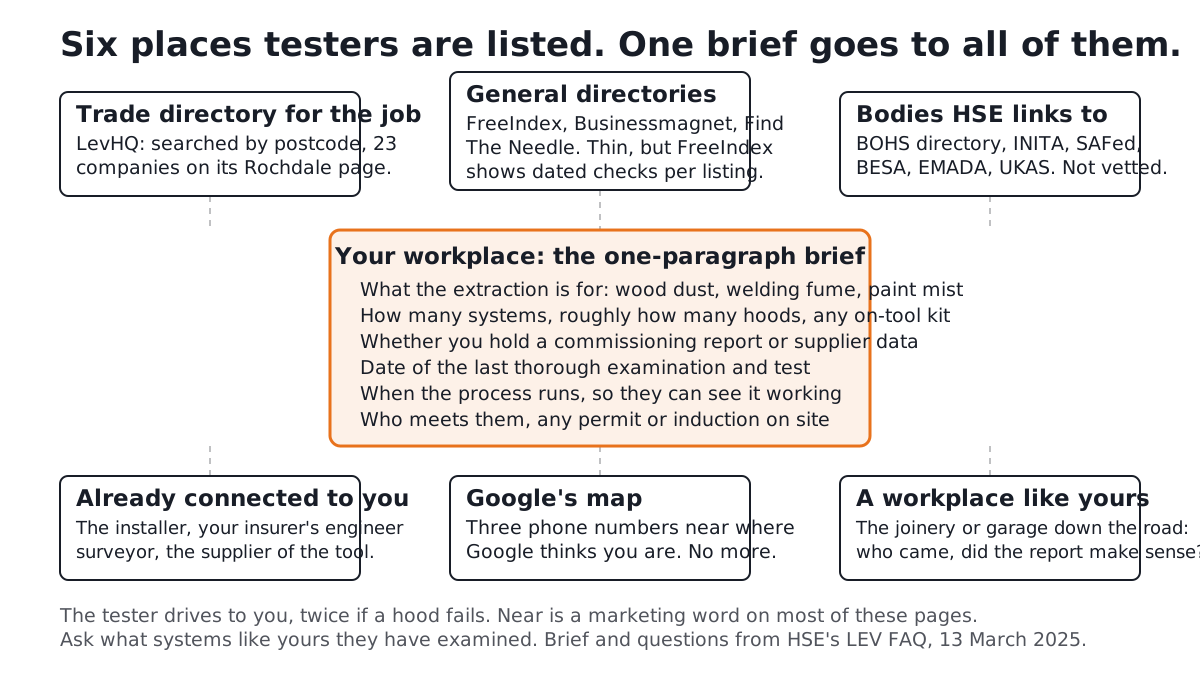
The six places testers are listed, and the brief that goes to all of them.
Two things stand out. First, nobody on that page is explaining anything. The results are places where testers are listed, not guides to picking one. Second, "near" on a web page is a marketing choice. The company behind the Hull area page gives a London address in its footer. The county directory page for Lancashire listed four companies, one of them based in Leeds, and offered to widen the search to 50 miles to find a fifth.
So the honest starting point is this: LEV testing is a small trade, the tester is going to drive to you, and the job is to find someone competent who covers your area, not someone whose office is in your town.
Six places testers are listed
Trade directories built for the job. LevHQ is ours, so treat this paragraph as a description rather than a recommendation. It lists LEV testing companies by area, searched from a workplace postcode. Its Rochdale page, which ranked for "lev testing companies" the day we looked, listed 23 companies, from national inspection bodies to one-person consultancies. Each listing shows what the company says about itself. LevHQ does not check those claims.
General business directories. Businessmagnet, FreeIndex and Find The Needle all had LEV testing pages in the results. FreeIndex is worth a look for one reason: its listings show dated verification checks, such as whether the email address works, the website is live and the company appears at Companies House. On the day we read it, the whole LEV testing category on FreeIndex held four companies. Thin, but the checks are real.
The bodies HSE links to. HSE's LEV useful links page, updated 4 December 2025, names the organisations it thinks are relevant, with a line on each. The British Occupational Hygiene Society (BOHS) offers qualifications that include LEV testing and, in HSE's words, its faculty "publishes a consultant directory to support workplace health and promote good practice". The Independent National Inspection and Testing Association (INITA) "represents independent companies that conduct inspection and certification of equipment, including LEV systems". The Safety Assessment Federation (SAFed) "represents many insurance companies that conduct inspection and certification of equipment, including LEV systems". UKAS runs an accreditation scheme for thorough examination and test. The Building Engineering Services Association (BESA) is "the main representative organisation for companies installing ventilation systems including LEV". EMADA is the trade association for extraction designers, manufacturers and installers. Schools should know about CLEAPSS, which HSE describes as "an advisory service offering guidance on LEV to educational establishments for ages 4-19".
One name on that page needs care. The Institute of Local Exhaust Ventilation Engineers (ILEVE) is listed by HSE as "though mothballed", and the CIBSE page for ILEVE says it moved to a dormant status in April 2024 and was replaced by a Workplace Exhaust Ventilation Group. If a company's website leans on ILEVE membership, ask what that means now.
HSE adds a caution under the list that applies to every directory in this guide: linking to an organisation does not mean HSE endorses it. Nobody on that page has been vetted by the regulator, and neither has anyone on ours.
People already connected to your building. The company that supplied or installed the extraction should have commissioned it, and often tests it too. If your insurer sends an engineer surveyor for your lifting equipment or pressure systems, ask whether the same firm tests LEV. Several of the companies ranking for LEV queries are statutory inspection businesses that also do LOLER and PUWER work. For portable or on-tool extraction, the equipment supplier may test the kit it sold you. Two of the pages we read were from a laser cutter supplier and a soldering equipment supplier doing exactly that.
The map. Google's local pack shows three businesses with a Google Business Profile near the point Google thinks you are searching from. It is a useful list of three phone numbers. It says nothing about competence, and it hides every company that covers your area from a depot forty miles away.
Another workplace like yours. A joinery, a college, a fabrication shop or a garage down the road has had the same test. Ask who came, whether they understood the process, and whether the report made sense.
What HSE says about choosing one
HSE's LEV frequently asked questions page, updated 13 March 2025, has a short section for employers on competence. It defines the word: "Competence is a combination of knowledge, skills and application experience that enables a person to do an effective and reliable job." On finding someone, it says that "some trade associations keep lists of members who claim LEV competence", and it tells you to write a simple description of the work, hand it to the candidate, ask what qualifications and experience they have and what types of LEV system they have worked on, and get more than one quote.
Note the word "claim" in that sentence. HSE is careful to say the lists are of members claiming competence. It does not maintain a list of its own, and it says elsewhere on the same page that it does not require any particular qualification.
The Health and Safety Executive for Northern Ireland puts the same advice in tender language on its LEV page. It suggests employers invite more than one tender, ask potential contractors to visit the site to see the processes, and ask about professional qualifications, experience, memberships, case studies and references.
How near is near enough
Distance matters for two reasons, and neither is the obvious one.
The first is the return visit. If a hood fails, HSE's FAQ says a competent person needs to check the repair before the failed label comes off. That is a second journey. A tester two hours away is two hours away twice.
The second is that the tester needs to see the process running. HSE's welding page tells employers to judge extraction by whether it captures the fume, not by airflow readings alone. So the visit has to happen when your welders are welding or your saws are cutting, and a tester who covers your area from a distance will want to fix the date and hold to it.
What distance does not tell you is whether the tester has seen your kind of system before. A spray booth, a woodworking system with a bag filter, a fume cupboard and a welding arm are different jobs. Somebody from the next county who has tested fifty booths is a better choice than somebody in your town who has not.
Multi-site businesses face a different trade. One national provider gives one report format and one renewal list. Local testers per site may know the regional trades better. Either works if the reports are read.
Northern Ireland is a separate jurisdiction with its own COSHH regulations, made in 2003 and enforced by HSENI. Its LEV page sets the same duty: a competent person, at least every 14 months.
What to send before anyone quotes
HSE's advice to "prepare a simple description of the work" is the whole trick. Most quote requests amount to: LEV test for our workshop. A tester cannot price that, so they either guess or ask to visit. Give them a paragraph instead.
Say what the extraction is for: wood dust, welding fume, paint mist, solvent vapour, soldering fume, flour. Say how many systems and roughly how many hoods, and whether any of it is portable or on-tool. Say whether you hold a commissioning report or the supplier's data sheet, and when the last thorough examination and test was. Say when the process runs, so they can see it working. Say who will meet them and whether any permit or induction is needed on site.
Then ask each candidate the same three things: what types of LEV system have you examined before, who on your staff would attend, and what information do you need from me before you can judge whether the system is working as intended. HSE's FAQ says a good examiner can tell you in advance whether they have enough to work with.
If the answers are similar, choose on price and dates. If one company cannot answer the third question, that tells you more than any listing.
Where LevHQ fits
LevHQ is a directory. A workplace types in a postcode, reads the profiles of testing companies covering that area, and can send one description of the job to up to three of them at once. That is the HSE method above with the retyping removed. LevHQ does not test anything, does not verify the qualifications a company lists, and does not set prices. A report tool for testers is being built and has not shipped. The live directory is at levhq.app.
Questions people ask
Can I do my own LEV test instead of finding a tester?
HSE's FAQ says carrying out a thorough examination and test "requires specialist skills and although it is possible to undertake this on your own, most businesses engage someone with specialist knowledge, experience and skills". The person doing it must be competent by HSE's definition. A manager with a clipboard is not. A trained employee with the instruments and experience can be.
Does the tester have to be local?
No. Nothing in COSHH or HSE guidance says anything about where the examiner is based. Distance affects the price of the visit and the ease of a return visit after a repair. Experience with your type of system matters more.
What qualification should I look for?
BOHS P601, Thorough Examination and Testing of Local Exhaust Ventilation Systems, is the course most testing companies name on their websites. HSE's FAQ names courses only as examples, requires none of them, and says a course by itself does not make a person competent. Treat P601 as evidence of training and ask about experience separately.
Is a directory listing or a map result a sign of competence?
No. A listing shows that a company exists and wants work. HSE's own links page carries a line saying that linking to an organisation is not endorsement. LevHQ shows the qualifications a company claims and does not verify them. Ask the examiner directly for evidence.
When should I start looking?
The deadline is 14 months from the date of the last thorough examination and test, or the shorter Schedule 4 interval for the processes it lists. HSE publishes no guidance on how far ahead to book. Work from the register of your last test dates, not from the calendar year, and start when a system is a few months from its date.
Sources
Fetched on 27 September 2026:
- HSE, LEV frequently asked questions
- HSE, LEV useful links
- HSE, maintenance, examination and testing of LEV and RPE (welding)
- COSHH Regulation 9, legislation.gov.uk
- HSENI, LEV (local exhaust ventilation) article; CIBSE, Institute of Local Exhaust Ventilation Engineers page; FreeIndex, Businessmagnet and Find The Needle listing pages; the LevHQ Rochdale page. Not linked from here.
Related guides: choosing between LEV testing companies, what LEV testing costs and LEV testing records and COSHH Regulation 9.