
Business tools guide
Choosing between LEV testing companies
By Jason Burns Published 8 minute read
Five kinds of company will test your extraction
We pulled the UK search results for "lev testing companies" on 27 September 2026. The ranking pages are a mixed bag: an exhibition listing for a manufacturer, an industrial supplies distributor, a lifting inspection group, a directory page, a healthcare page from a testing firm, two general business directories and a jobs board. Sort them and you get five kinds of business. All of them sell COSHH compliance, the phrase on nearly every page. What differs is what else they sell.
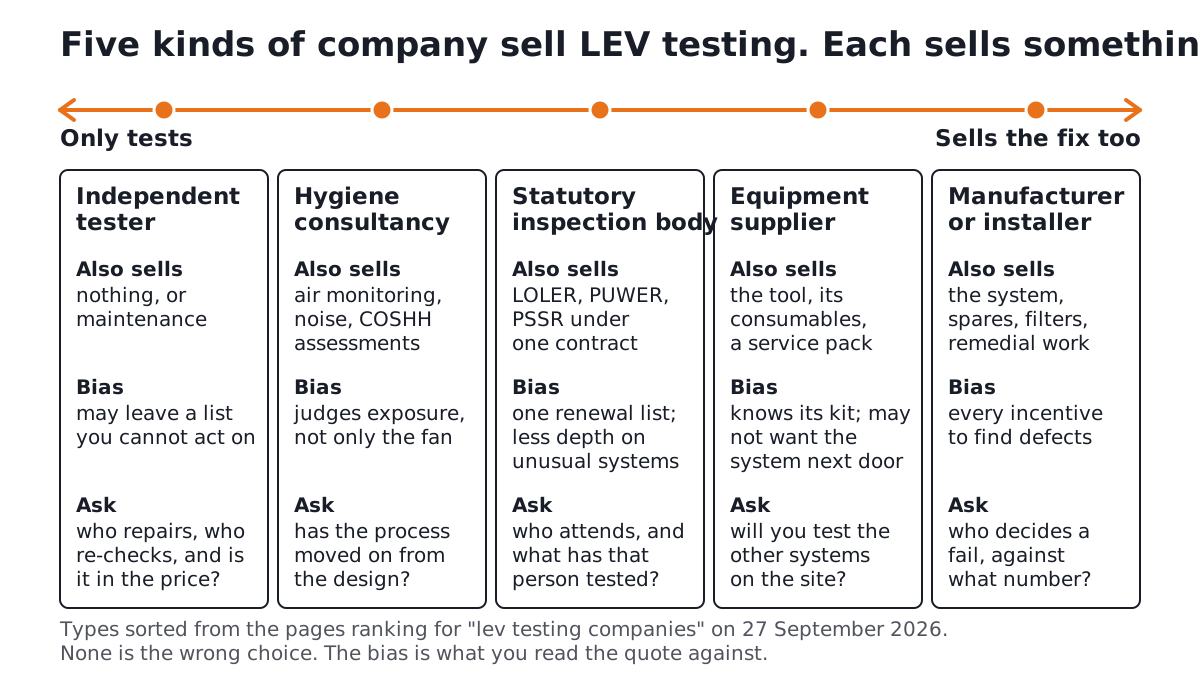
The five company types, what else each one sells, and the question that reads its quote.
| Type | Who they are | What they also sell | Example from the pages we read |
|---|---|---|---|
| Independent testing specialist | Small firms that only examine and test | Nothing, or maintenance | LEV Tec Solutions, which says it focuses "solely on inspection, testing, and ongoing maintenance - not design or installation" |
| Manufacturer or installer | Companies that design, build and fit extraction systems | The system, spares, filters, remedial work | Nederman, Filtermist, Beam |
| Statutory inspection body | Firms that inspect lifting gear, pressure systems and work equipment | LOLER, PUWER and PSSR examinations under one contract; laboratory fume cupboard testing | WH Scott, Plant and Safety, TUV SUD |
| Occupational hygiene consultancy | Hygienists who measure airborne contaminants and assess exposure | Air monitoring, noise, COSHH assessments | NOHH, Airborne Environmental Consultants |
| Equipment supplier | Sellers of tools that come with extraction | The tool, consumables, a service pack | A laser cutter supplier, a soldering equipment supplier, an industrial supplies distributor |
None of these is the wrong choice. Each has a bias, and knowing the bias is how you read the quote.
An installer knows extraction better than anyone and can fix what it finds, which is also why you ask who decides a hood has failed. A statutory inspection body will fold LEV into the same visit as your lifting equipment and give you one renewal list, and may have less depth on unusual process extraction. A hygiene consultancy will tell you whether exposure is controlled, not just whether the fan is pulling. An equipment supplier knows its own kit and may be the only sensible choice for a filtered laser enclosure or a soldering extractor, and may not want to test the woodworking system in the next room.
What the letters on their websites mean
Almost every page we read names BOHS P601. Fewer explain it.
The British Occupational Hygiene Society runs a set of proficiency modules. Its P601 page describes the course as "Thorough Examination and Testing of Local Exhaust Ventilation Systems" and says it "is suitable for anyone who is responsible for testing and maintaining LEV systems". It is "a level 4 qualification in the BOHS qualifications framework", "typically conducted over four days, which comprises a minimum of 24 hours of learning time", and candidates "must pass four parts within 12 months". BOHS recommends sitting P600, methods for testing LEV performance, first if the candidate lacks the basics, and lists P602 on design principles, P603 on personal protective equipment and P604 on performance evaluation, commissioning and management as the modules that follow.
So a P601 holder has passed a four-day course and an assessment on examining and testing LEV. A P602 holder has studied design. A P604 holder has studied commissioning and managing systems. COSHH Regulation 9 itself names no course. It requires the examination to be thorough and HSE's guidance requires the examiner to be competent to control exposure to hazardous substances. One company on the results page states its engineers hold P601, P602, P603 and P604. A manufacturer whose page we read states P602 and P604 with no mention of P601. For a thorough examination and test, P601 is the relevant one, and HSE's FAQ is clear that no course is required by law and that a course alone does not make a person competent.
The other letters are memberships and accreditations, and they mean different things.
UKAS runs, in the words of HSE's useful links page, an "accreditation scheme for 'Thorough examination and test'". A company accredited under that scheme has had its examination procedures assessed. Read accreditation claims closely: one consultancy whose LEV page we read states in a footnote that its UKAS accreditation covers asbestos surveys, air testing and bulk sample analysis only.
INITA represents independent inspection companies. SAFed represents insurer-owned inspection bodies. BESA represents ventilation installers. EMADA represents extraction manufacturers and installers. Membership tells you what kind of company it is, not whether the examiner attending your site is competent.
ISO 9001 is a quality management standard. It says nothing about LEV.
"HSG258 compliant" and "HSE compliant" are the company's own descriptions. HSE does not certify reports or companies.
Independence, and who fixes what they find
HSE's page for designers, installers and examiners describes the examiner's role as to "detect and remedy system defects". That sentence contains the trade-off.
A company that sells extraction and remedial work has every incentive to find defects. A company that only tests has every incentive to leave you with a list you cannot act on. Neither incentive is fatal, if you know which one you have hired and ask the right question.
For an installer or manufacturer, the question is: who decides a hood has failed, against what benchmark, and can I see the measurement. A fail should be a number below a benchmark, plus an observation, not an opinion. For an independent, the question is: if a hood fails, who does the repair, and who comes back to check it. HSE's FAQ says a competent person has to check a repaired hood before its failed label comes off, so a test-only firm has to send someone back or hand that check to whoever did the repair.
The lifting inspection group whose page ranked third says its examiners test, its own engineers quote and do the remedial work, then retest. Convenient, and the same company on both sides of the fail. Decide whether that suits you before the visit.
A test is not exposure monitoring
One occupational hygiene consultancy, cited in Google's AI answer for "what is lev testing", makes a point every buyer should hear: "LEV testing does not directly measure worker exposure." An examiner confirms the system performs as designed. Whether the design still matches the work, whether operators stand where the hood can reach them, and what they actually breathe are different questions. HSE's welding guidance makes the same point from the other side: judge the extraction on whether it captures the fume, not on airflow numbers alone.
If your processes have changed since the extraction was designed, or nobody has ever measured exposure, a hygiene consultancy may be the better first call. If the system is simple and unchanged, a competent tester is enough.
Comparing quotes on the same brief
Quotes only compare if they answer the same description. Write one paragraph covering the processes, the substances, the number of systems and hoods, what documentation you hold, and when the process can run for the examiner. Send it to three companies of different types, and ask each what its price includes from this list, drawn from the scope one inspection body publishes for its own examinations:
- review of commissioning data, the log book and previous reports;
- visual and structural examination of hoods, ducting, dampers, fans and enclosures;
- airflow, face velocity, capture velocity and transport velocity measurement;
- static pressure and pressure drop readings at defined test points;
- filter condition and loading;
- functional checks of alarms, airflow indicators and interlocks;
- qualitative capture testing with smoke and a dust lamp, with the process running;
- clearance time testing for spray booths and enclosures;
- assessment of operator position and technique;
- defects graded by urgency with remedial recommendations;
- a report, labels, and any online record or portal.
Then ask three questions the list does not cover. Is the re-check after a repair included or a second call-out. If you have no commissioning data, will you set a benchmark on this visit and what does that add. Will the person who quoted attend.
Companies quote per system and per hood, so a quote that does not state how many hoods it covers is not yet a quote. Published prices are covered in a separate guide on this site.
Ten questions before you book
- What types of LEV system have you examined in the last year, and how many like mine?
- Who will attend, and what training and experience does that person have?
- What information do you need from me to judge whether the system is working as intended?
- Will you watch the process running, and what do you need from us to make that happen?
- Which measurements will you take at each hood, and what will you compare them against?
- How do you grade defects, and how will I know which ones stop work?
- If a hood fails, what happens on the day, and who does the re-check after repair?
- Do you sell or fit extraction, and if so how do you separate that from the examination?
- What does the report look like? Ask for a redacted sample.
- Can I speak to two customers with similar processes?
HSE's FAQ expects a competent supplier to be able to give references, and suggests that if the cost is high it may be worth visiting other sites where the supplier has installed LEV. The last question is HSE's advice, not ours.
Signs to walk away
A fixed price with no questions asked about hoods, processes or documents. A certificate with no measurements behind it. A company that cannot say what benchmark it will test against. Any use of the phrase HSE approved. A claim that the law requires an annual test, when the regulation says 14 months. A claim that only P601 holders may legally test, when HSE requires competence and names no qualification. None of these proves incompetence. Each shows a company not reading the guidance you are.
Where LevHQ fits
LevHQ lists UK LEV testing companies by area, shows what each says about itself, and lets a workplace put the same brief to three of them from a single form. That gets you three quotes on the same brief without retyping it. LevHQ does not sort companies into the types above, does not verify qualifications or memberships, and does not test anything. The tester report tool is still in development. The directory can be used now at levhq.app.
Questions people ask
Should the company that installed my extraction also test it?
It can, and it knows the system. The risk is that the same company decides what has failed and sells the fix. If you use the installer, ask to see the measurements behind any fail and the benchmark they were judged against. For a second opinion, an independent tester or a hygiene consultancy can examine the same system.
What is P601?
A BOHS proficiency module, Thorough Examination and Testing of Local Exhaust Ventilation Systems. BOHS describes it as a level 4 qualification taught over about four days with a minimum of 24 hours of learning, assessed in four parts. It is the course most LEV testers hold. HSE does not require it, and says a course alone does not make a person competent.
How many quotes should I get?
HSE's FAQ says to always get more than one. Three is enough to see the spread, and mixing types, say an installer, an independent and an inspection body, shows where the price differences come from.
Are national LEV testing companies better than local ones?
Neither is better by default. A national body gives one report format across sites and may bundle LEV with lifting and pressure inspections. A local specialist may know your trade and be cheaper to bring back for a re-check. Judge the person who attends, not the size of the company.
Do LEV testing companies have to be accredited?
No. There is no legal requirement for accreditation, membership or a named qualification. UKAS runs an accreditation scheme for thorough examination and test, and bodies such as INITA and SAFed represent inspection companies, but the legal requirement is that the examiner is competent.
Sources
Fetched on 27 September 2026:
- HSE, LEV frequently asked questions
- HSE, LEV information for designers, installers and examiners
- HSE, LEV useful links
- HSE, maintenance, examination and testing of LEV and RPE (welding)
- COSHH Regulation 9, legislation.gov.uk
- BOHS, P601 course page; WH Scott, LEV testing and thorough examination page; LEV Tec Solutions listing on FreeIndex; Impact Technical Services, LEV testing and healthcare pages; Beam Central Systems, what is LEV testing; NOHH Ltd, what LEV testing does; Airborne Environmental Consultants, LEV testing page; Nederman exhibitor listing; Hall-Fast, LEV testing post. Commercial pages, not linked from here.
Related guides: how to find an LEV tester near you, what LEV testing costs and how to read an LEV test report.