
Business tools guide
What HSE actually publishes about LEV testing
By Jason Burns Published 8 minute read
HSE publishes, it does not certify
People searching for "hse lev testing" tend to want one of three things: a register of HSE-approved testers, a certificate HSE issues, or the rule. The first two do not exist. HSE does not test your extraction, approve testing companies or issue anything to a workplace after a test. What HSE does is publish guidance, free, across about fifteen pages and three documents.
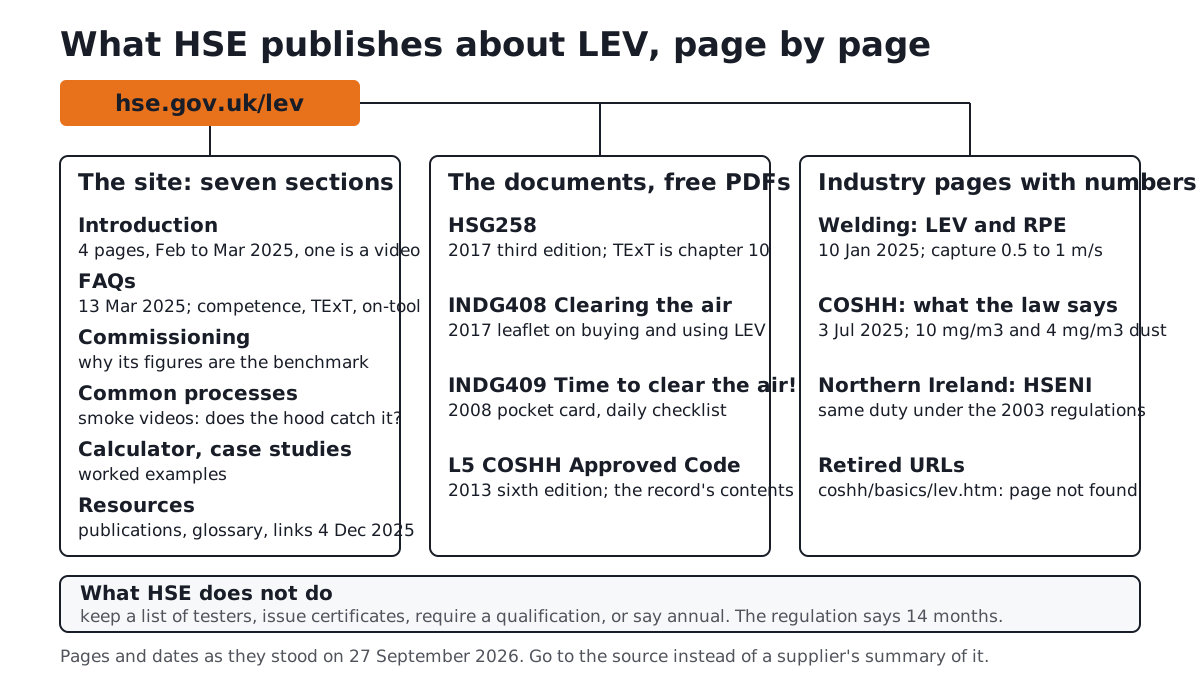
HSE's LEV publishing, mapped. Dates are the ones each page showed on 27 September 2026.
This guide maps those pages as they stood on 27 September 2026, with the date each showed at its foot. Where a supplier's website tells you what HSE requires, check it here.
The LEV pages on hse.gov.uk
HSE keeps a small site at hse.gov.uk/lev. Its index lists seven sections: an introduction to LEV, the FAQs, commissioning, common processes, a calculator, case studies and resources.
Introduction to LEV. Four short pages, all dated February or March 2025. "What is local exhaust ventilation" is a video. The employers page opens with a sentence worth pinning up: "Many employers buy LEV to protect workers' health but find that it doesn't work." It then lists key messages for buying LEV and for using it. The six for using it are: manage the checking and maintaining of the system, train employees to use it, follow the user manual, fill in the log book and get repairs done, get it thoroughly examined and tested, with the word annually in inverted commas, and use the examination report as an audit. The employees page carries a daily checklist. The designers, installers and examiners page describes an examiner's job as to "detect and remedy system defects to ensure that LEV systems continue to deliver effective control" and gives examiners four key messages: examine against the commissioning report or an equivalent, use every relevant assessment technique, label every hood tested with a red label for failures, and provide a full report.
Frequently asked questions. Updated 13 March 2025. This is the page most worth reading in full. It is split into airflow, competence, thorough examination and test, and on-tool extraction, and it answers the questions employers actually ask: whether airflow indicators are required (no specific legal requirement, but HSE recommends them), whether examiners must label hoods (no, but recommended), what competence is, whether HSE requires qualifications (no), what the test is for, what the examiner needs, what the report should contain, and who is responsible for hired on-tool extraction (the hire company). It is the only HSE web page with an outline of what a test record should contain, in a table for on-tool extraction: visual examination results, damage, indicator checks, the velocity or pressure the unit is judged against, and the actions needed.
Commissioning. The page carried a May 2026 date in search results when we looked. It describes what a commissioning report should include and why the commissioning figures are the benchmark for every later test.
Common processes and sources. HSE videos showing, with smoke, whether a hood catches the cloud from a circular saw, a spray gun or a welding torch.
Resources. Publications lists the two free leaflets and the priced book. The glossary defines twenty-one terms, each with a pointer to the HSG258 chapter behind it. Useful links, updated 4 December 2025, lists the trade and professional bodies HSE considers relevant, with a caution that a link is not to be "taken to mean endorsement by the HSE of the site to which it points".
HSG258, the book behind every test
HSG258, Controlling airborne contaminants at work: a guide to local exhaust ventilation, is the document every testing company cites. HSE's catalogue page gives its date of publication as 2017, its series code as HSG258, and offers the PDF free. It is the third edition, and the page says this edition "has been updated and contains minor amendments and clarifications, but the advice is broadly unchanged".
The catalogue page describes the audience: "This guidance is for employers who use, or intend to use LEV. It will also help suppliers of new LEV equipment." It lists the contents as "the roles and legal responsibilities of employers and suppliers; competence; principles of good design practice for effective LEV hoods and their classification; ducts; air movers; air cleaners; and system documentation - with checking and maintenance schedules and the marking of defective equipment".
HSE's glossary tells you where to look inside it. Competence is chapter 2, airborne contaminants chapter 3, sources chapter 4, specification and quotation chapter 5, hoods chapter 6, ducts, fans and air cleaners chapter 7, commissioning chapter 8, log books and user manuals chapter 9, and the thorough examination and test chapter 10.
When a company's website says its reports are "HSG258 compliant", it means a report laid out along the lines of chapter 10. HSE does not certify reports, so the phrase is the company's own.
The two leaflets and the code of practice
INDG408, Clearing the air. A free leaflet, dated 2017 in its current revision, subtitled "A simple guide to buying and using local exhaust ventilation (LEV)". HSE's page says the revision "emphasises the duties of employers in relation to LEV and the support that can be provided by others, eg suppliers and designers". Read it before buying extraction.
INDG409, Time to clear the air! A free pocket card from 2008 for employees who work with dust, mist, fume or gas. HSE's page says it "contains a daily checklist to make sure it is working properly". Give one to every operator.
L5, the COSHH Approved Code of Practice. Sixth edition, 2013, free as a PDF. HSE's page says it "provides practical advice to help dutyholders comply with the requirements of the COSHH Regulations". This is where the detail on what an examination record should contain lives. HSE's FAQ refers examiners to its paragraphs 186, 187 and 189 for how to cover an examination where no design data exists.
The industry pages that add numbers
HSE's LEV site avoids numbers. Its industry pages do not.
The welding page on maintenance, examination and testing of LEV and RPE, updated 10 January 2025, says LEV performance "can be tested for comparison to the capture velocity range 0.5m/s to 1m/s" for welding fume, soldering and liquid transfer, that higher velocities may be needed where draughts interfere, and that for on-torch extraction "capture velocity measurement is not appropriate" and total volume flow against the manufacturer's recommendation is the check.
HSE's COSHH "What the law says" page, updated 3 July 2025, gives the dust thresholds that bring an otherwise unclassified dust into COSHH: "10 mg/m3, as a time-weighted average over an 8-hour period, of inhalable dust, or 4 mg/m3, as a time-weighted average over an 8-hour period, of respirable dust". That settles whether COSHH applies to your dust at all, from the regulator rather than a testing company.
What HSE says you must do, and what it says you should do
HSE's own wording separates the two, and suppliers often blur them. The duty underneath all of it is COSHH's: prevent or control exposure to hazardous substances. LEV is one way of doing that, and the testing duties follow from choosing it.
You must maintain the LEV in efficient working order. That is Regulation 9(1) of COSHH and HSE's FAQ repeats it. You must keep the record of the thorough examination and test for at least five years, from Regulation 9(4). The examination at least every 14 months is Regulation 9(2)(a), and HSE's welding page uses the word must for it.
You should, in HSE's words, have airflow indicators or an equivalent way of knowing the system is working, keep information on the system's intended performance for the life of the equipment, get a report that follows the ACOP, and label hoods. None of those is a specific legal requirement on its own. Each is HSE's view of how to meet the duty to maintain.
One thing HSE never says is that the examiner must hold a particular qualification. Its FAQ names training courses as examples and requires none. At least one supplier page we read states that an LEV test needs a P601-qualified engineer. That is the supplier's rule, not HSE's.
What HSE does not do
It does not keep a list of testers. Its FAQ points to trade bodies whose members claim competence, and its links page names those bodies, with the disclaimer above.
It does not issue certificates. A certificate is a testing company's document. The legal record is the report.
It does not say "annual" as a rule. The regulation says 14 months. One supplier page we read attributes the 14-month interval to the Health and Safety at Work etc. Act 1974. It is in COSHH Regulation 9.
Some HSE URLs that other websites link to no longer exist. On 27 September 2026, hse.gov.uk/coshh/basics/lev.htm returned HSE's page-not-found page. The live pages are the ones linked from the LEV index.
Northern Ireland
HSE's guidance covers Great Britain. In Northern Ireland the regulation is the Control of Substances Hazardous to Health Regulations (Northern Ireland) 2003 and the regulator is HSENI. Its LEV article says every LEV system "requires a statutory thorough examination and test by a competent person, at least every 14 months", that the employer should keep the report for at least five years, and it points to HSG258 for the detail.
Where LevHQ fits
None of the pages above will find you a tester. LevHQ is a postcode-searched directory of UK LEV testing companies, with a single form that puts the job to three of them. It is a place to apply HSE's advice on choosing a competent person. LevHQ does not test and does not verify the qualifications companies list. Its report tool for testers is unfinished and unreleased. The directory is at levhq.app.
Questions people ask
Does HSE approve or register LEV testers?
No. HSE's FAQ points to trade bodies whose members claim competence, and its links page names those bodies while stating that a link is not an endorsement. Any company describing itself as HSE approved is using words HSE does not use.
Do I need an LEV test for HSE?
You need one because COSHH Regulation 9 requires it, and HSE enforces COSHH in Great Britain. An inspector visiting a workplace that uses extraction can ask for the last thorough examination and test report and for the record of repairs. The test itself is done by an examiner you appoint, not by HSE.
Is HSG258 free?
Yes. HSE's catalogue page offers the PDF free; the printed book is priced. INDG408, INDG409 and the COSHH Approved Code of Practice L5 are also free as PDFs.
Does HSE require examiners to hold P601?
No. HSE's FAQ says a training course by itself does not make a person competent, and it requires no named course. BOHS P601 is the most widely held course for thorough examination and testing, and it is reasonable to ask for it, but the legal test is competence.
Sources
Fetched on 27 September 2026, with the date each HSE page showed at its foot:
- HSE, local exhaust ventilation index
- HSE, LEV information for employers (25 February 2025)
- HSE, LEV information for employees (24 February 2025)
- HSE, LEV information for designers, installers and examiners (24 February 2025)
- HSE, LEV frequently asked questions (13 March 2025)
- HSE, commission your LEV system
- HSE, common processes and sources
- HSE, LEV glossary of terms (13 March 2025)
- HSE, LEV useful links (4 December 2025)
- HSE, HSG258 catalogue page (7 August 2025)
- HSE, INDG408 Clearing the air
- HSE, INDG409 Time to clear the air!
- HSE, L5 COSHH Approved Code of Practice
- HSE, maintenance, examination and testing of LEV and RPE (10 January 2025)
- HSE, COSHH: what the law says (3 July 2025)
- COSHH Regulation 9, legislation.gov.uk
- HSENI, LEV (local exhaust ventilation) article; BOHS, P601 course page. Not linked from here.
Related guides: what LEV testing is, in plain English and LEV testing records and COSHH Regulation 9.