
Business tools guide
How often an automatic gate needs servicing, and what a service should cover
By Jason Burns Published 9 minute read
There is no number in the law
Automatic gate servicing is a planned visit by a gate automation engineer to inspect, lubricate, adjust and safety-test a powered gate, with a written record of what was found. Ask how often an electric gate should be serviced and the honest answer is that the law does not give a figure. HSE's powered gates guidance says gates "will need to be checked regularly and maintained to remain safe in use", and lists among the basics that they are "installed and maintained by competent contractors" and "regularly checked (which may include inspection, testing, and adjustment for safety)". Regularly is the word. The interval is left to the manufacturer's instructions and the risk.
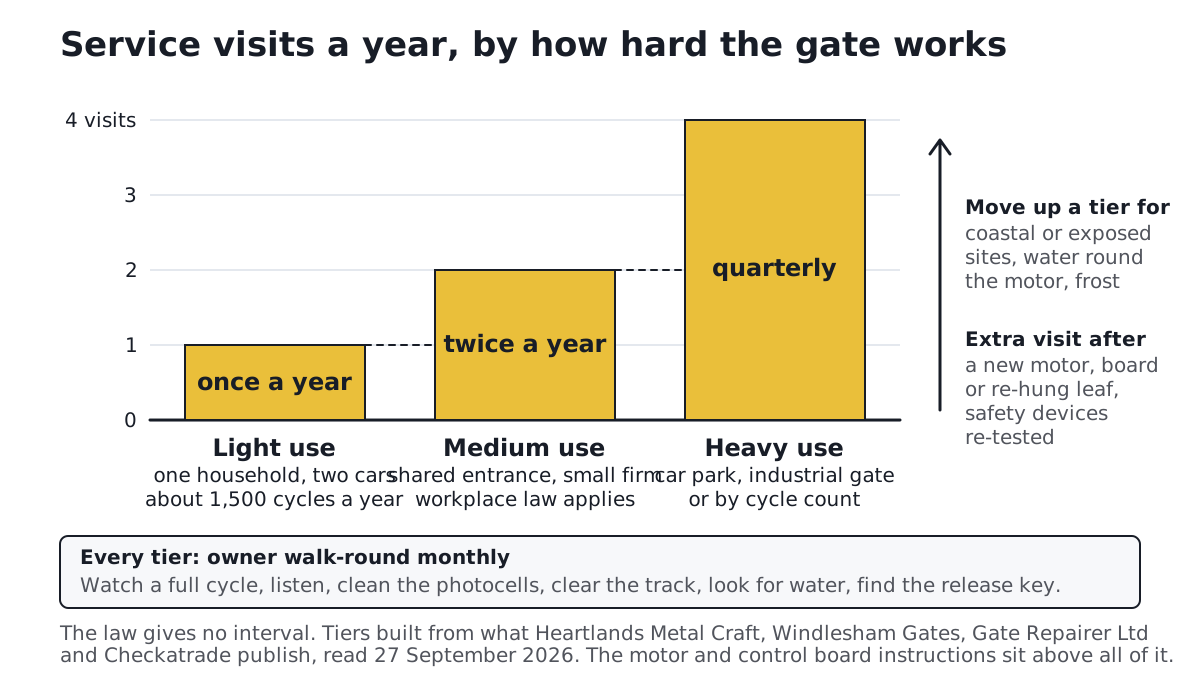
Once, twice or four times a year, built from what the trade publishes. The law gives no figure.
HSE points the frequency question back at the documents that came with the gate. The User Instructions should include information "on routine maintenance and the nature and periodicity of safety checks", and the owner "should study the User Instructions that must come with the product, assessing what servicing and inspection/safety checks may be necessary". So step one is to find the handover pack and read what the installer wrote down. If there is no pack, the interval has to come from somewhere else. The rest of this guide is about where.
What the trade publishes
The gate companies ranking for "automatic gate servicing" in the UK on 27 September 2026 give intervals that agree more than you might expect.
| Company | Published interval |
|---|---|
| Heartlands Metal Craft | "If it's heavily used, bi-annual servicing may be necessary; for lighter-use systems, a single annual maintenance service should suffice if a reliable system has been installed." |
| Windlesham Gates | "It's recommended to conduct routine maintenance every 6-12 months. However, high-usage gates or those exposed to extreme weather may require more frequent checks." |
| Gate Repairer Ltd | "Annual, twice-yearly or more frequent visits considered according to usage, environment and site risk." |
| Checkatrade | "Lubricating hinges and moving parts twice a year" and "scheduling a professional service annually to inspect wiring and automation systems" |
| Automated Gate Solutions | "We provide three different levels of servicing so that you can choose the right one for you." |
The pattern: once a year for a lightly used gate, twice a year for a busy one, more often where the environment is harsh. Nobody publishes an interval longer than twelve months. Gate Repairer's three factors, "usage, environment and site risk", are the ones to work from. The manufacturers' own instructions for the motor and control board sit above all of these, where the installation left them with the owner.
Building a schedule from usage
Think in cycles, not months. A gate on a private drive that opens four times a day does roughly 1,500 cycles a year. A shared entrance serving thirty flats, with visitors and deliveries, could pass that in a couple of months. A barrier on a business car park could pass it in weeks. The same motor, hinge and photocell wear at very different rates, and HSE's safety page is plain about the result: "Component parts can wear and fail, sometimes catastrophically."
Light use: one household, one or two cars. One professional service a year, with an owner walk-round every month or two. Checkatrade's twice-a-year lubrication of hinges and moving parts is a reasonable owner task between visits if the instructions allow it. Windlesham says "you can usually carry out basic tasks like cleaning, lubrication, and visual inspections yourself", and to use a qualified installer "for electrical repairs, motor servicing, or complex mechanical issues".
Medium use: shared residential entrances, small business premises. Two visits a year. This is also where the law changes. HSE says a gate that is part of a workplace, or in the common parts of a residential complex, is covered by health and safety law, and it expects landlords and managing agents to keep the standard of "inspection and maintenance" that an employer would. A managing agent booking one visit a year for a gate used by thirty households is at the light end of what the trade publishes for that usage.
Heavy use: car parks, industrial entrances, sliding gates with constant traffic. Quarterly, or on a cycle count if the control board keeps one. Gate Repairer describes the wear pattern: "Frequent vehicle movements place extra demand on sliding gates, barriers and safety edges. Servicing addresses mechanical wear, track condition, photocells and dependable opening cycles."
Any gate after a change. A new motor, a new control board, a re-hung leaf. HSE says substantial modifications "may require re-assessment". A service after the work, with the safety devices re-tested, is the minimum.
Weather moves every tier up a notch. Windlesham's page covers the seasonal causes: cold that leaves metal parts "brittle and more prone to cracks or breaks", heat where "high temperatures may also impact electronic components", and rain, where "moisture ingress could lead to electrical faults" and water can pool around the motor housing "or any underground components". A coastal site or an exposed drive on a hill is a harsh environment even at light use.
What a service should cover
An invoice that says "annual service" tells nobody what was checked. The pages we read describe the visit in enough detail to build a checklist.
Gate Repairer's description of a planned service is the fullest: "visual and operational inspection, cleaning and lubrication where appropriate, mechanical and automation checks, testing of fitted safety devices, manual-release checks and a record of findings and recommendations". It splits the mechanical side into "hinges, rollers, rack, track, stops, fixings, manual release and physical gate condition" and the automation side into "motor operation, controls, limits, photocells, edges and stop or reverse behaviour".
Heartlands names the safety components that need attention, "photocells, contact safety edges, and loop detectors", and says access devices should be "updated with the latest software". Windlesham covers the structure: hinges inspected "for any signs of wear, rust, looseness, or damage", motor casings checked "for signs of corrosion or dirt", and a listen "for unusual noises when the gate operates".
Put together, a service visit should leave evidence of seven things.
- Structure. Hinges, posts, welds, rollers, track and end stops. Anything loose, worn or moving.
- Drive. Motor operation, gear or rack condition, oil leaks on hydraulic units, manual release working and its key present.
- Controls. Limits set correctly, slow-down zones, remotes and keypad, intercom, any timer or auto-close.
- Safety devices. Each photocell tested by breaking the beam, each safety edge tested for stop and reverse, loop detectors, emergency stop where fitted.
- Force. Where the gate relies on force limitation for safety, HSE says objective force testing "along the lines of EN12445" is needed at handover and again "to subsequently check the product remains safe". Ask whether the service includes a force test with readings, or only a look at the edges.
- Environment. Drainage around the motor, water in housings, growth in front of photocells, debris in the track.
- Record. What was found, what was adjusted, what needs doing before the next visit, and the recommended date.
If a service quote does not mention items four and five, ask. A lubricate-and-go visit is maintenance. It is not a safety check.
What a service costs
Two published figures, as those companies' prices on 27 September 2026. Gate Repairer Ltd lists "a one-off planned gate service" at "£300 + VAT per gate, per visit", with "discounted multi-gate pricing" possible where several gates on one site are done in one visit. Checkatrade's electric gate repair page gives hourly labour for gate work at £65 to £85. Automated Gate Solutions offers three service levels without publishing prices. A contract that bundles a discounted call-out rate is worth pricing against two one-off visits plus one breakdown.
Owner checks between visits
The engineer sees the gate twice a year. You see it every day. HSE says users should be given information "on how to safely switch the gate off, or into a safe mode such as hold-to-run, and where necessary, how to release a person if they become trapped by the gate". Make sure everyone who uses the gate knows that before anything else.
Then a monthly walk-round that needs no tools.
- Watch a full open and close. Does it run smoothly and stop cleanly at both ends?
- Listen. Windlesham lists "grinding, scraping, screeching, rattling" as signs of "worn gears, debris buildup, lack of lubrication, motor strain".
- Look at the photocells. Clean the lenses and clear anything growing in front of them.
- Look at the track or the swing path. Clear leaves, gravel and ice.
- Look for water. Standing water around an underground motor housing after rain is a fault waiting to happen.
- Check the manual release key is where it should be.
Do not test a safety edge by standing in the gate's path. That is what the engineer's instruments are for. If anything in the walk-round is wrong, book the engineer early rather than waiting for the scheduled visit.
Why the record matters
HSE says "records of servicing, repair and testing may help to demonstrate what has been done and how the gate is being left safe", and that they "could also be useful as a benchmark for subsequent safety checks". Keep every service sheet in one place with the handover pack, and put the next due date somewhere visible. For a domestic gate there is no legal duty to do any of this. HSE still recommends that domestic gates "are checked regularly", and points out that a householder can still be liable for harm the gate causes.
Questions people ask
Four questions from the "people also ask" box for automatic gate servicing, answered from the company pages named under sources. Checkatrade's cost table carries the note "Last updated: May 2024".
How much does it cost to service an electric gate?
Gate Repairer Ltd publishes £300 plus VAT per gate per visit for a one-off planned service. Checkatrade's cost guide table gives an "electric gate annual service cost" of £150 to £750, average £450, as ballpark averages. A maintenance contract is priced differently again, so compare it against two one-off visits and one breakdown call-out.
What is the lifespan of an automatic gate motor?
Checkatrade's cost guide says you could expect a residential gate motor to "last 15 years" with light loading and proper installation, on the basis that most residential motors "can open and close around 100,000 times". At four openings a day that is well over 60 years; at a shared entrance doing 60 cycles a day it is under five. The cycle count, not the calendar, is the number to watch.
How do I service a gate motor myself?
You do not, beyond cleaning and looking. Windlesham says an owner can carry out "cleaning, lubrication, and visual inspections" and should use a qualified installer for "electrical repairs, motor servicing, or complex mechanical issues". HSE says anyone working on a powered gate should have the mechanical, electrical, hydraulic or pneumatic knowledge the job needs, and that force testing needs specialist equipment. Opening the motor housing is where the owner's job ends.
What are the common problems with automatic gate openers?
Laporte Gate Automation's page lists the causes in one line: "Components wear, electrical connections can corrode, safety sensors get misaligned and control boards can fail." Add water in the motor housing after rain and debris in the track, both of which the monthly walk-round above will catch before they become a call-out. Our repair guide covers what to check when the gate has already stopped.
Where GateHQ fits
GateHQ is being built and is not available yet; the plan includes service reminders for people responsible for automatic gates.
Sources
Fetched on 27 September 2026:
- HSE, Powered gates: the basics
- HSE, Powered gates: legal responsibilities
- HSE, Ensuring powered doors and gates are safe
- Heartlands Metal Craft, "Why professional electric gate servicing is important"; Windlesham Gates, "Essential electric gate maintenance tips"; Gate Repairer Ltd, electric gate repairs in High Wycombe; Automated Gate Solutions, Cobham page; Solar Gates, automated gate servicing in Canterbury; Checkatrade, electric gate repair in Uxbridge and its "Find electric gate repair near me" cost guide; Laporte Gate Automation, maintenance and repairs page. Commercial pages, not linked from here.
Related guides: electric gate not working: what to check and who to call and automated gate maintenance records.