
Business tools guide
Electric gate repairs: the common faults, what they cost and what a proper repair includes
By Jason Burns Published 8 minute read
Read the symptom before you read the price
Gate companies describe faults by what the owner sees, not by the part that failed, because one symptom has several causes. Gate Repairer Ltd's area pages list eight, each with the usual suspects behind it. The table is their list, quoted, with one addition from Checkatrade.
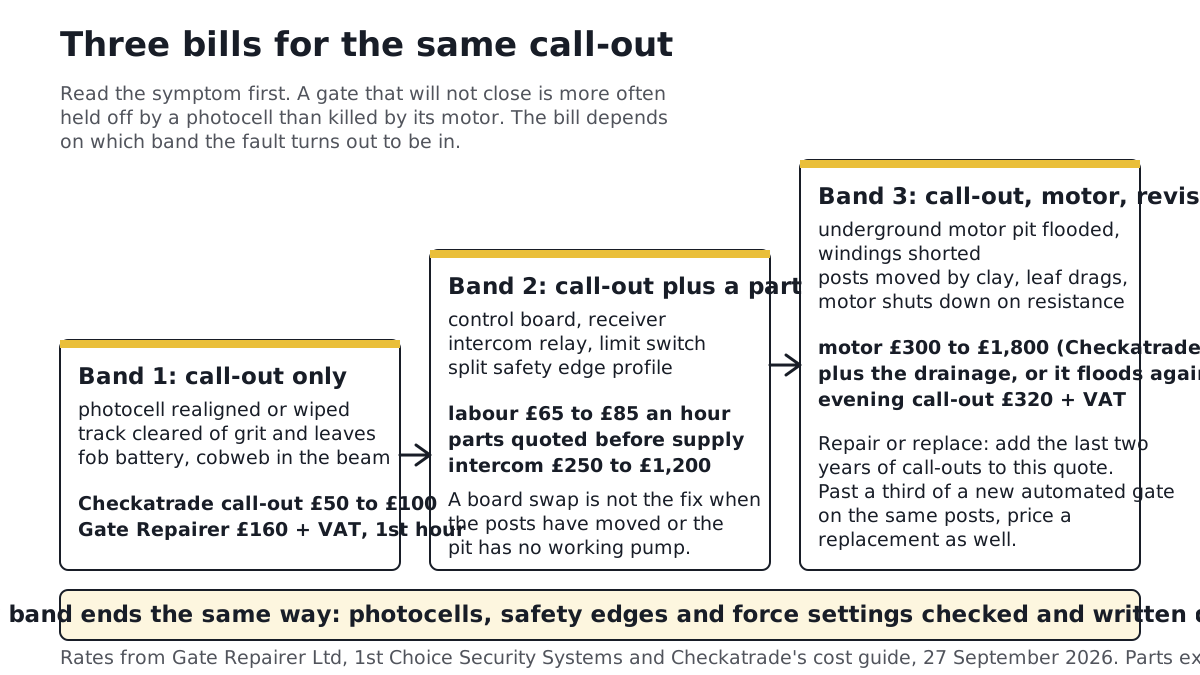
The same call-out, three different bills, and the check that ends every repair.
| What the gate does | What the engineers say is usually behind it |
|---|---|
| Will not open or close | "Power-supply, fuse, isolation, safety-input, control-board or motor faults." |
| Stops halfway or reverses | "Mechanical resistance, alignment problems, force behaviour or safety-device activation." |
| Remote works some of the time | "Receiver, antenna, transmitter, interference, range or damaged wiring problems." |
| Slow, noisy or uneven | "Worn hinges, rollers, track, rack, motor components or poor gate alignment." |
| Photocell fault shown | "Misalignment, obstruction, water ingress, impact damage, failed equipment or broken cabling." |
| Safety edge fault shown | "Damaged profiles, failed transmitters, receiver problems, flat batteries or circuit faults." |
| Keypad or intercom dead | "Keypad, intercom relay, GSM, receiver, loop or control-panel integration faults." |
| Dragging or hitting the ground | "Hinge wear, post movement, track problems, damaged rollers or structural alignment issues." |
| Opens and closes on its own | Checkatrade: "interference in the radio frequency" or "the motion sensors are detecting movement." |
Notice how often the safety devices appear. A gate that refuses to close is more often being told not to by a photocell than suffering a dead motor. 1st Choice Security Systems, writing about North London repairs in August 2026, says "a control board replacement isn't necessarily the solution" and that most problems "come down to three specific issues".
Water, clay and grit
The ground moves. 1st Choice describes London clay that "swells when it's wet and shrinks when it dries out", pulling timber, iron and steel posts out of line over the years. Once the hinges bind or a leaf drags, "the motor senses physical resistance and shuts down to prevent motor burnout". The motor is fine. The posts have moved.
The motor pit floods. Underground swing gate motors sit in a steel box below ground. 1st Choice: "If therefore, the soakaway blocks or there is no active pump, the pit floods, submerging the motor casing, breaching the seals, and shorting out the electrical windings." This is the fault that turns a cheap visit into a motor replacement, and it is why the repair should include the drainage, not just the motor.
The track fills. On sliding gates, "fallen leaves, road grit, and gravel fall into and become compacted in the floor track". The carriage hits the debris, the board reads it as an obstacle and stops the gate.
The safety devices do their job. Cobwebs, dirt or condensation break a photocell beam. A split rubber safety edge lets water short the safety loop. In both cases, 1st Choice says, "the gate locks open as a safety precaution". A gate stuck open on a Friday night feels like a failure. It is the design working.
Usage decides how often all of this happens. Gate Doctors says that in busier towns "regular gate use can place extra strain on motors, controls and safety systems", so a shared entrance or a commercial site should book checks more often than a private driveway with two cars.
What a repair costs
Two sets of published figures, both fetched on 27 September 2026.
Checkatrade's electric gate repair cost guide gives national averages. Its table puts the call-out charge at £50 to £100 with an average of £75, labour at £65 to £85 an hour, and an annual service plan at £150 to £750 depending on whether it is yearly, twice yearly or quarterly. Replacing "a faulty or broken motor" runs £300 to £1,800. Repairing or replacing an intercom is £250 to £1,200.
Gate Repairer Ltd publishes its own rates and says they are "confirmed before attendance":
| Gate Repairer Ltd | Published rate |
|---|---|
| Standard weekday call-out, including travel and the first hour | £160 + VAT |
| Each further hour, weekdays | £80 + VAT |
| Evening and weekend call-out, including the first hour | £320 + VAT |
| Each further hour, evenings and weekends | £160 + VAT |
| Emergency attendance, including the first hour, subject to availability | £340 + VAT |
| Travel beyond 15 miles | £0.45 per mile |
| One-off planned service, per gate | £300 + VAT |
Parts are on top.
Put those together and electric gate repairs fall into one of three bands. A photocell realigned, a track cleared or a fob battery changed is one call-out and nothing else. A control board, receiver or intercom is a call-out plus a part in the low hundreds. A drowned underground motor is a call-out, a motor at Checkatrade's £300 to £1,800, and possibly a second visit for the drainage. Emergency attendance costs more because someone has to be available: Wakefield Electric Gates aims "to be on-site within four hours", and Gate Repairer's emergency rate shows what that availability costs.
Repair or replace
Checkatrade says good electric gate systems "should last for 15 to 20 years" if properly installed and regularly maintained, and that a residential motor can be expected to "last 15 years" under light loading, on the basis that most are designed for around 100,000 open and close cycles. A gate on a shared entrance uses those cycles in a fraction of the time.
Gate Safe's advice for owners is that "if the gate is ten years old or you do not know the history of the gate, you should have it checked by a Gate Safe installer to ensure its safe operation". That check is the moment to price the options honestly.
Gate Doctors takes the repair-first view: "In many cases, repair is the best first step". That is right for a five year old gate with a failed board and wrong for a fifteen year old gate with a drowned motor, moving posts and photocells from a brand nobody stocks.
Our rule of thumb, not anyone else's: add the last two years of call-outs to the quote in front of you and compare the total with the replacement figures in our installation cost guide. Once repairs pass a third of a new automated gate on the same posts, get a replacement quote alongside the repair quote and decide with both in hand.
A repair is not finished when the gate moves
HSE's guidance for anyone repairing powered gates as part of their work is that "following any maintenance or repair work the gate must be left safe", that the person doing it should be able to verify and test both the parts and the finished gate, and that specialist equipment may be needed "to test force limitation values". It adds that "ideally access to exact settings (eg force limitation) should be kept secure from interference", and that the owner should be told why those settings matter.
The trade says the same from the other side. 1st Choice: "any repair that replaces a motor, changes control board parameters, or adjusts physical geometry requires a post-repair safety check", because a motor whose force is "turned up too high to compensate for stiff hinges or a dragging track" is how a 300 kilogram gate becomes a hazard. Intelligent Security and Fire, a Gate Safe accredited firm, says "poorly executed repairs can compromise both functionality and safety".
On the standards. HSE names BS EN 12453 as "the key standard" for gate control systems and refers to force testing "along the lines of EN12445". 1st Choice's page also cites "DHF TS 011". The Door and Hardware Federation's own legislation page, fetched the same day, names its current Code of Practice as DHF TS 013:2021, in three parts, with Part 3 written for owners and managers. We did not find TS 011 on the DHF pages we read, so treat that number as the repair company's citation, not ours. HSE also notes that following these standards is not mandatory in itself; the legal duty is to leave the gate safe.
The practical test: ask, before booking, whether the visit ends with the photocells, safety edges and force settings checked and written down. If the answer is that they fix what is broken, that is a mechanic, not a gate engineer.
What to have ready when you ring
Engineers fix more on the first visit when they know what they are walking into. Wakefield Electric Gates says its engineers "carry spare parts for the most common systems, allowing us to fix many faults on the first visit". Intelligent Security says its engineers "carry a stock of the most common replacement parts so that often the repair can be completed during a single visit". Both need to know the make first.
Gate Repairer asks callers to describe the fault, give the full postcode and gate type, and send photos of the motor, controller or damage, taken only where it is safe to do so. The brand list on its Epsom page, CAME, FAAC, BFT, NICE, Beninca, Genius, DEA, AES, Videx, Hikvision and Commtel, is the sort of list to check your control board label against before you choose who to call.
Say three things on the phone: the symptom in the words of the table above, the make and model from a photo, and whether the gate is stuck open, stuck closed or moving wrongly. Only the last is urgent for safety; our guide on what to check before you call covers switching it off.
Where GateHQ fits
GateHQ is being built and cannot be used yet; the plan is a directory of electric gate engineers with job enquiries, so a description of the fault and a photo of the control board could reach local engineers in one go.
Questions people ask
What are the most common faults on electric gates?
The companies we read list the same set: power and fuse faults, failed or worn motors, control board faults, photocells blocked or misaligned, damaged safety edges, remotes and receivers, intercoms and keypads, and mechanical wear in hinges, rollers and tracks. 1st Choice says most of its North London call-outs come down to three: flooded underground motor pits, dirty photocells and posts moved by clay.
How much does it cost to repair an electric gate?
Checkatrade's national averages are a £50 to £100 call-out, £65 to £85 an hour for labour, £300 to £1,800 for a replacement motor and £250 to £1,200 for an intercom. Gate Repairer Ltd publishes a standard call-out of £160 plus VAT including the first hour, then £80 plus VAT an hour, with parts on top.
How long should electric gates last?
Checkatrade says 15 to 20 years for a properly installed and maintained system, and about 15 years for a lightly loaded residential motor, based on a design life of around 100,000 cycles. Gate Safe suggests a safety check by a trained installer once a gate reaches ten years old or its history is unknown.
Can an electrician repair an electric gate?
An electrician can restore the supply and check the wiring. Setting force limits, testing safety edges and leaving a powered gate safe is specialist work. HSE says anyone working on powered gates should be able to verify and test the final product, with specialist equipment where needed, and Gate Safe says a general electrician should not work on gate automation without specific gate training.
Sources
Fetched on 27 September 2026:
- HSE, Powered gates: legal responsibilities
- HSE, Ensuring powered doors and gates are safe
- Gate Safe's advice for gate users and the Door and Hardware Federation's legislation and standards page, neither linked from here.
- Trade pages, none linked: Gate Repairer Ltd (Epsom and Wimbledon), 1st Choice Security Systems (London and Hitchin), Gate Doctors (Surrey), Intelligent Security and Fire, Wakefield Electric Gates, BGS (Bournemouth) and Checkatrade's repair cost guide.
Related guides: what to check and who to call when a gate stops, installation costs and the servicing schedule.