
Business tools guide
What an electric gate costs to install in the UK, and what the quote should include
By Jason Burns Published 8 minute read
The short answer, with its sources
Ask five UK companies what electric gates cost and you get five ranges that overlap. Checkatrade's cost guide, whose table says it was last updated in June 2026, puts most residential installations at £3,000 to over £8,000 and gives around £5,000 as the average for a residential electric driveway gate. Abbey Gates, an installer working across Central Scotland, puts a fully automated electric gate at £3,500 to £12,000, "with most standard installations landing between £5,000 and £8,000". Driveway Gates London says £4,500 to £10,000 for a standard London property. Helions Forge says a complete residential installation "often sits between £6,500 and £9,500".
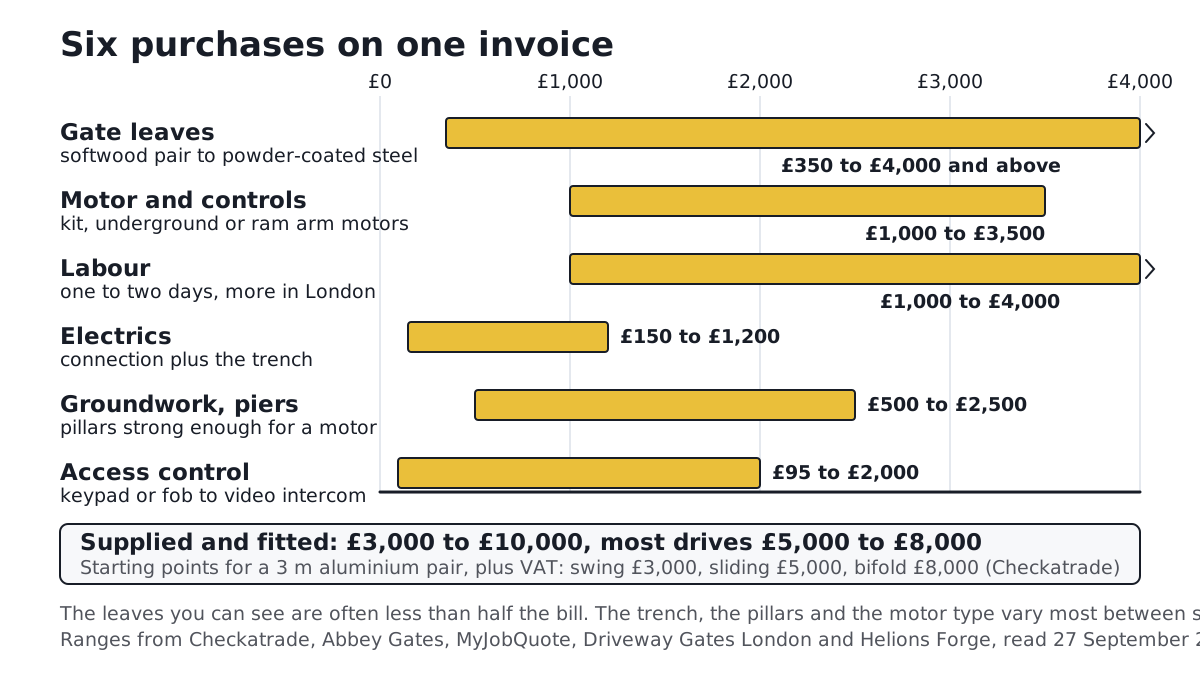
The six lines on a gate quote and the published range for each. The leaves are often less than half the bill.
So a supplied and fitted electric gate on an ordinary drive costs between £3,000 and £10,000, and most land near £5,000 to £8,000. The rest of this guide explains why the range is that wide.
Every price here was read from the company's own page on 27 September 2026 and is that company's figure. Checkatrade marks its tables as plus VAT. Where a company does not say, assume VAT is on top until the written quote says otherwise.
What you are paying for
An electric gate is five purchases on one invoice. Splitting them out is the only way to compare two quotes.
| Part of the job | Published figures | Who says so |
|---|---|---|
| The gate leaves | 3 metre aluminium swing gate £1,500+ supply, sliding £3,000+, bifold £5,000+. Softwood pair £400 to £800, composite £800 to £2,000, hardwood £1,200 to £2,500+, powder coated steel £350 to £4,000+, all supply only | Checkatrade; Abbey Gates |
| Motor and controls | £1,000 to £1,800. Automation kit £1,000 to £3,500. Underground motors £600 to £1,200 each, ram arm motors £300 to £700 each, sliding gate motor £500 to £900 | Checkatrade; Helions Forge; Driveway Gates London |
| Labour | Around £2,500. £1,000 to £4,000 on top of the gate price. One day at £300 to £500 for a single metal gate on a threaded arm, one to two days at £425 to £800 for an underground motor | Checkatrade; Abbey Gates; MyJobQuote |
| Electrics | £600+ to run services to the gate. £150 to £400 for the connection plus £300 to £750 for trenching. £400 to £1,200 where the cable run is over 10 metres and crosses a path or drive | Checkatrade; MyJobQuote; Driveway Gates London |
| Groundwork and piers | Groundworks £500+, brick piers £1,000+. Pillars strong enough for electric gates £1,000 to £2,500 | Checkatrade; MyJobQuote |
| Access control | Intercom £500 to £1,500, 4G intercom £1,200. Wired intercom £200 to £400, video or smartphone £1,000 to £2,000. Keypad or fob £95 to £250 | Checkatrade; MyJobQuote; Helions Forge |
The metal or timber you can see is often less than half the bill. The parts that vary most between sites are the ones nobody photographs: the trench, the pillars and the motor type.
Swing, sliding or bifold
The opening mechanism sets the starting price more than the material does.
Swing gates are the cheapest to automate. Checkatrade's supply and install figure for a 3 metre aluminium pair is £3,000+. Driveway Gates London calls ram arm motors on a swing gate "the most budget-friendly automation route", with labour to fit a set at £300 to £600.
Sliding gates cost more. Checkatrade says £5,000+ for the same size in aluminium, "because they often require additional tracks, drainage and groundwork". Driveway Gates London puts a complete sliding system at £3,500 to over £8,000. A sliding gate suits a short drive where swinging leaves would hit the car, and a drive that slopes towards the road.
Bifold gates fold in half as they open, for the tightest sites. Checkatrade says £8,000+. Helions Forge calls them "the most mechanically complex and generally the most expensive option".
What moves the price on your site
Checkatrade lists the factors: gate size, gate type, material, the automation system, intercom and access systems, groundworks and the distance from the house to the gate for the electrical supply. Three deserve a closer look.
Distance. Every metre of cable is a metre of trench. MyJobQuote's trenching figure of £300 to £750 and Driveway Gates London's £400 to £1,200 for a long run under a hard surface are the same cost seen from two ends of the country.
Ground. Abbey Gates says the top of its £1,000 to £4,000 installation range reflects "awkward access, sloping ground or heavy clay soil". Underground motors sit in a box below the hinge, hidden when the gate is closed; Driveway Gates London prices them at £600 to £1,200 each against £300 to £700 for a visible ram arm, and the hidden box is the one that floods.
Location. Abbey Gates quotes day rates of £200 to £350 outside London and £300 to £500 in London and the South East. The gate costs the same in Perth and Putney. The labour does not.
Automating a gate you already have
If the existing gate is sound, adding a motor is cheaper than starting again. Abbey Gates puts a basic swing motor kit at £800 to £1,800 fitted, with a fuller package including a keypad, remotes or a video intercom adding £1,500 to £3,000.
Kits are sold direct. The Electric Gate Shop lists a Maxim single swing farm gate kit at £425.50, or £510.60 including VAT, and a double kit at £582.75, or £699.30 including VAT.
Gate Safe, the charity that trains installers and keeps a register of them, says on its page for gate owners: "Unless you are a fully trained Gate Safe Aware installer, the purchase of an automatic gate kit should be avoided. These kits are typically supplied without sufficient safety for a fully automated gate." On using a general electrician: "You should only use a trained gate automation installer to upgrade manual gates unless your electrician has had specific automated gate training."
HSE's position is that converting a manual gate to powered operation is covered by the same law as a new gate, and that the person who does the conversion usually takes on the manufacturer's duties for the finished machine, including the Declaration of Conformity. If that is you with a kit and a Saturday, those duties are yours.
What a quote should include
Checkatrade lists what a full quote should set out: gate supply, automation systems, motors, intercoms, electrical work, groundworks, testing and commissioning, waste removal and VAT where applicable. A quote missing one of those lines is not cheaper. It is incomplete.
Two more lines belong on the list, and they come from HSE rather than a trade site.
The first is the paperwork. HSE's powered gates guidance says that when a gate is first supplied or first put into service "all customers are entitled to receive" User Instructions "and a Declaration of Conformity in English", with conformity marking and labelling fixed to the gate. Ask the installer to confirm in the quote that these will be handed over. Our guide to gate maintenance records explains what to do with them.
The second is the safety check before you accept the gate. HSE says: "During commissioning but before hand-over, the installed product will need to be checked for safety and benchmarked for subsequent safety inspections." Where the gate relies on force limitation to stop it crushing someone, HSE expects the handover to include the force limits and how they can be checked. "Testing and commissioning" on a quote should mean that test, with the readings written down.
Abbey Gates gives the practical version: "getting two or three quotes on the same specification gives a fair comparison". Gate Safe's register and the Door and Hardware Federation's member list are two places to find the companies; HSE names both bodies as providers of powered gate competence training.
Planning permission
In England, the Planning Portal says you do not need planning permission for a new gate if, next to a highway used by vehicles or its footpath, it does not exceed one metre from ground level, or two metres elsewhere, provided the property is not a listed building or within the curtilage of one and the right to put up gates has not been removed by an article 4 direction or a planning condition. In a conservation area you may need permission to take a gate down. The Portal notes that Wales may differ.
Abbey Gates points out where this bites: "Most residential gates are specified at 1.2 to 1.8 metres, comfortably within the 2 metre limit away from a highway but over the 1 metre limit right on a road boundary." A gate on the pavement line needs to be a metre high or needs an application. Abbey says the current fee in England for works along a house boundary is £272; that is Abbey's figure and we have not checked it against the fee schedule.
What it costs after the installer leaves
Electricity is almost nothing. Checkatrade puts the annual bill under £15, Abbey Gates under £20, Helions Forge at £15 to £20. Rolling Center's page reaches £18 a month instead, but its arithmetic assumes a 500 watt motor running eight hours a day, which no driveway gate does.
Servicing is the real running cost. Checkatrade says annual maintenance plans typically cost around £150 a year. Abbey Gates says £80 to £200 per visit. Helions Forge and Patron Security both say £150 to £300 a year. How often a gate needs that visit, and what it should cover, is in our servicing guide. Timber adds one more line: Abbey Gates says wooden gates need "oiling or repainting every one to two years".
Where GateHQ fits
GateHQ is in development and not yet available; the plan is a directory where people arranging an installation could send one description of the site to several local gate companies for quotes.
Questions people ask
How much does it cost to install an electric gate?
On the published figures, £3,000 to £10,000 supplied and fitted for a residential drive, with most jobs at £5,000 to £8,000. Checkatrade's starting points are £3,000+ for a 3 metre aluminium swing pair, £5,000+ sliding and £8,000+ bifold, plus VAT. The gate leaves are often less than half of that.
Do you need planning permission for electric gates?
In England, not if the gate is no higher than one metre where it stands next to a road or its footpath, or two metres elsewhere, and the property is not listed or restricted by an article 4 direction or planning condition. That is the Planning Portal's summary. Most gates are 1.2 to 1.8 metres, so a gate on the road boundary usually needs an application.
What are the downsides of electric gates?
Cost, upkeep and the fact that a powered gate is a machine. Servicing runs at roughly £80 to £300 a year on the figures above, and HSE treats a powered gate as machinery that must be commissioned, documented and kept safe. Electricity is under £20 a year.
Is it cheaper to automate the gate I already have?
Usually. Abbey Gates puts a basic swing motor kit at £800 to £1,800 fitted against £3,500 to £12,000 for a new automated gate. The gate and posts must be strong enough for the motor, the installer takes on the manufacturer's duties for the converted gate, and Gate Safe advises against fitting a kit yourself.
Sources
Fetched on 27 September 2026:
- HSE, Powered gates: the basics
- HSE, Powered gates: legal responsibilities
- HSE, Ensuring powered doors and gates are safe
- The Planning Portal's page on fences, gates and garden walls, Gate Safe's advice for gate users and the Door and Hardware Federation's legislation page, none linked from here.
- Cost pages from Checkatrade, MyJobQuote, Abbey Gates, Driveway Gates London, Helions Forge, Patron Security, Rolling Center and The Electric Gate Shop, all commercial and not linked.
Related guides: gate repairs, faults and costs, the servicing schedule and the records to keep.