
Sports clubs guide
Club membership software: what a volunteer committee actually needs
By Jason Burns Published 8 minute read
The member list is the club
Every other job on the committee depends on one list being right. The treasurer needs to know who has paid. The coach needs to know who is insured to be on the water. The welfare officer needs the emergency contact for the junior who has just twisted an ankle.
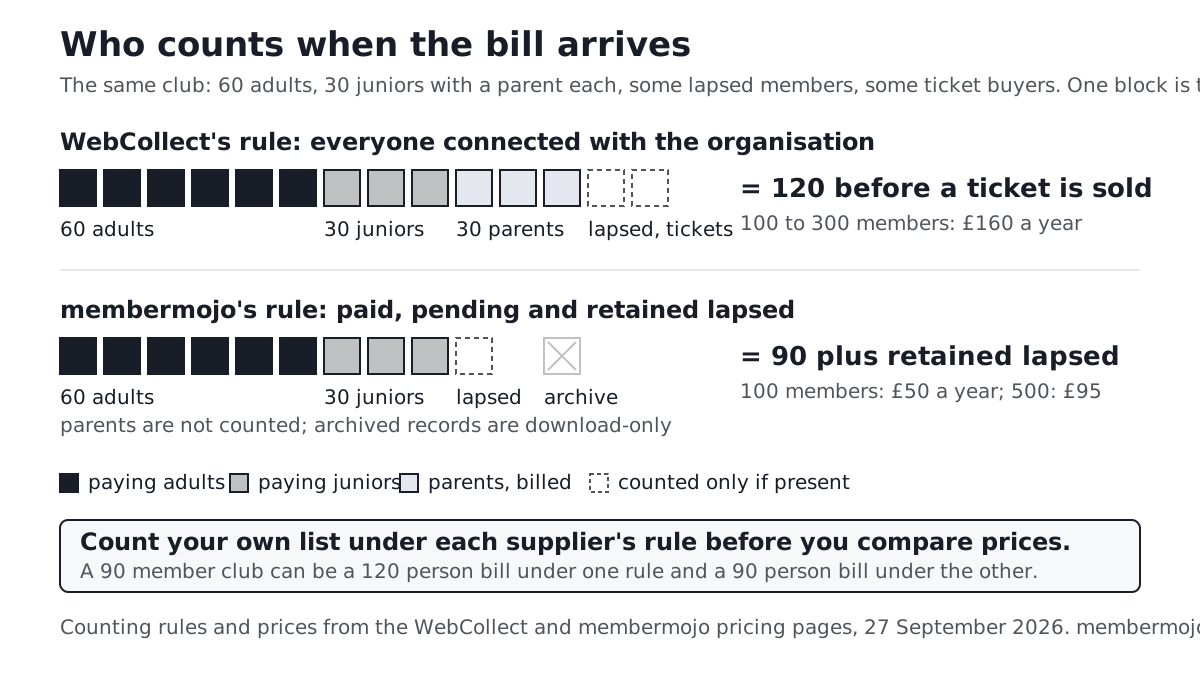
One club, two counting rules. The parents attached to junior subscriptions are the difference.
ClubMon's guide puts the job in one sentence: "Club membership management is the work of keeping a sports club's member list accurate, its fees up to date, its training schedule visible, and its admin under control." When it goes wrong, the same guide says, "it eats the secretary's Tuesday evenings and the treasurer's weekends".
That is the test for club membership software. Not the number of features. Whether one person, doing this on top of a job, can keep the list right with an hour a week.
What belongs on the record
A member record that does its job holds these, and nothing the club has no reason to keep:
- Name, contact details and date of birth where the club has junior categories.
- Membership category and the date it runs to.
- Payment status: paid, pending, lapsed, and how they paid.
- An emergency contact. Manage My Club lists "emergency contacts" alongside sessions, groups and finances in its member management.
- Qualifications that matter to the sport, with expiry dates. myClubhouse describes recording "expiry dates and report on status across membership" for certifications and licences.
- For juniors, the responsible adult and the consents the club asks for.
- Roles and permissions: who is on the committee, who coaches, who can see what.
- Notes the club would be embarrassed to lose: the member who needs a ground floor changing room, the one who asked not to be photographed.
Start the new record from this list and add only what a named person will use.
Events and attendance belong on the same record, not in a separate sheet. membermojo includes an attendance register in every plan and WebCollect handles event registration and booking, so when a place is booked against the member the treasurer can track who paid and the coach can see who turned up. Suppliers call this billing or CRM; for a club it is one list doing several tasks.
The membership year and renewals
Renewals are where spreadsheets fail first, because a spreadsheet does not know what day it is.
Clubs run their year in one of two ways, and the software has to support yours. WebCollect describes both: "annual subscriptions that all end on the same fixed date each year with pro-rata subscriptions for new members who join during the year", or renewal from the date each member joined. membermojo lets you create membership levels "with renewal aligned to your financial year or from the date of application".
Then the chasing has to be automatic. membermojo: "No more chasing members for renewal - renewal and expiry notices are sent automatically." It keeps lapsed records so that "late renewals will not have to re-key details", and archives them after a retention period the club sets. That is the difference between a database and a pile: a member who lapses in March and comes back in September should find their record waiting.
One detail to check with any supplier: can you import members with their existing expiry dates? membermojo says you can "import members with past or future expiry dates" and let the system chase from there. Without that, the first year on a new system means every renewal date typed by hand.
Taking the money
Most clubs collect subs several ways at once, and good software records all of them against the member. WebCollect's description covers the range: "credit or debit cards, bank transfer, cash, cheque, direct debit, or PayPal", with instalments, and then the part the treasurer cares about: "reconcile your payments against your bank statements" and "export your financial data into your accounting package". membermojo lets the committee "notify members when their offline payment, such as cheque or bank transfer, has been received", so the member who paid by transfer is not chased as a defaulter.
Online payments carry fees, and they are the real cost of most "free" club software. These rates are what each company published on 27 September 2026.
- membermojo: no membermojo transaction charge. PayPal takes 2.9 percent plus 30p; Stripe takes 1.5 percent plus 20p on standard UK cards. Stripe needs the £95 a year plan or higher.
- WebCollect: Direct Debit costs 0.5 percent, no VAT, up to a £2 cap, and GoCardless adds 1 percent. PayPal is 10p a transaction plus PayPal's own fee. Cards need a £70 set-up and 30p a payment plus the bank's cut.
- Pitchero: payment processing from 2.42 percent plus 17p on its Standard plan and from 1.67 percent plus 15p on Pro; its free plan has no payment processing.
- SportsHQ apps: membership fees and event entries paid online through Stripe, per the SportsHQ site.
Direct Debit is worth a hard look for annual subs. On WebCollect's published rates a £120 subscription costs 60p to WebCollect and £1.20 to GoCardless, against £3.78 through PayPal at 2.9 percent plus 30p. Across a hundred members that is £180 against £378 a year. The sums are ours; the rates are theirs.
Juniors, guardians and consent
A junior section changes the record. The person paying, responding and receiving emails is a parent, and the club is holding information about a child. WebCollect supports "junior subscriptions with parental consent forms" and requires each junior to be in a group with at least one adult who has family admin status. Spond lists adding guardians as a feature of its app. Manage My Club's incident book logs "everything from what happened to whether the member's parent's have been informed". Our own RowHQ and KanuHQ let parents handle junior responses and consent information from their own account.
Decide before the import who can see a child's record. A coach needs the emergency contact, not the parent's payment history.
Talking to the right people
The usual committee complaint about messaging is that everything goes to everyone. The fix is a member list that already knows who is a junior parent, who is a coach and who rows on Tuesdays.
membermojo's approach: "send an email to a single address and let membermojo forward to members", from a list that is always current. myClubhouse: "Target precise segments of your membership using live member lists that are always up to date", with SMS as well as email. WebCollect sells SMS credit packages, 500 texts for £50, for the messages that cannot wait for an inbox.
Handing the job on
Membership secretaries change. The record has to outlive them.
Three things make that possible. Multiple administrators, so the job is never one login on one laptop: membermojo says "multiple administrators can be added with permission to view or edit the database". Roles and permissions, so a new committee member can be given the membership job without the treasurer's. And a full export at any time, so the club is never locked in: membermojo's tour page says "we understand this is your data and that it should be easy to extract", and lets you "download a spreadsheet copy of the entire membership database at any time" with a unique id per member.
Ask every supplier for the same three things in writing before you sign. A product that cannot answer the export question clearly is telling you how the relationship ends.
Data protection without the lecture
The club is responsible for the personal data it holds, wherever it is stored. That does not change when you move from a spreadsheet to a supplier. What changes is that a supplier is now processing it for you, and you should have a written agreement covering that. WebCollect published a Data Processing Agreement alongside its privacy notice in 2018; membermojo has a UK GDPR help page. Ask any supplier where theirs is. Keep only what a named person uses, set a retention period for lapsed members, and give access by role. None of this is legal advice; it is the practical shape of the duty.
What it costs, and who counts
Membership software in the UK is mostly priced by member count, and the definition of a member is where the surprises live.
membermojo charges one annual fee including VAT: nothing up to 50 members, then £50 a year at 100, £95 at 500, £175 at 1,000 and £300 at 2,000. Its count includes members "that have paid or are pending payment, and those retained for use after membership has lapsed", but not records in the download-only archive. Pass the tier mid-year and you upgrade, with a refund for the unused time on the old plan.
WebCollect charges an annual fee too: up to 50 members free, 50 to 100 members £80, 100 to 300 £160, 300 to 500 £230, 500 to 750 £320. Its count covers everyone "connected with your organisation": every member on the list "even if they do not yet have a valid subscription or their subscription has expired", the parents attached to junior subscriptions, and "people who have bought event tickets from your organisation". A club with 90 paying members, 30 of them juniors, can be billed as a 120 person club before it has sold a single ticket.
SportMember prices per head instead: its PRO plan is £0.16 per member per month with a minimum of £22 a month excluding VAT, and a Basic plan at £0. Pitchero prices by team, £38 or £99 a month, not by member. SportsHQ says its RowHQ and KanuHQ apps cost nothing for a club of up to 20 active members, with SailHQ pricing confirmed per club; those are our products, so check their own sites.
Count your own list under each supplier's rule before you compare prices.
Where the SportsHQ apps fit
RowHQ, SailHQ and KanuHQ each hold the member record described here alongside what their sport needs: boats and crews, duty rotas and qualifications, trips and kit. They are part of the SportsHQ collection; the sports clubs page explains the problems behind each one, and sportshq.app carries current features and pricing. If your sport is not one of those, the checklist above applies to whichever supplier you choose.
Questions people ask
What should a club membership record contain?
Contact details, membership category and renewal date, payment status, an emergency contact, sport qualifications with expiry dates, the responsible adult and consents for juniors, and roles and permissions. Keep only what a named person on the committee will use.
Who counts as a member when a supplier bills us?
Whoever the supplier's own rule says. WebCollect counts everyone connected with the organisation, including lapsed members, the parents attached to junior subscriptions and event ticket buyers. membermojo counts paid, pending and retained lapsed records but not archived ones. Count your list under each rule before comparing prices, because a 90 member club can be billed as a 120 person one.
How do we move our members off a spreadsheet?
Clean the spreadsheet down to the columns in this guide, import it with existing expiry dates so the software can chase the next renewal, add at least two administrators, and let existing members meet the system at their renewal rather than all at once. That last step is membermojo's own advice for a switch.
Sources
All supplier pages were fetched on 27 September 2026: ClubMon's club membership management guide, membermojo (homepage, pricing, membership database tour), WebCollect (homepage, pricing), myClubhouse, Manage My Club, SportMember, Pitchero's pricing page and Spond's UK homepage. None is linked from here because they are commercial pages. sportshq.app is our own site.
Related guides: choosing club management software for a small club, and the sport guides on boat bookings, duty rotas and paddling sessions.